Choosing the cheapest license in Dubai today could be the most expensive mistake your business makes by 2026. While the meydan free zone vs mainland debate often centers on initial fees, the real decision rests on where your customers live and how you plan to manage your 2026 tax obligations. You’re likely feeling the pressure of new corporate tax regulations and the anxiety of potential banking hurdles that often plague new entities. It’s frustrating to realize that a setup which looks perfect on paper might restrict your access to the lucrative UAE local market or government contracts.
We understand that you need a license that simplifies visa processing and protects your bottom line. This guide provides a clear ROI comparison to ensure your setup is future-proof and scalable. We’ll break down operational reach, setup costs for the coming year, and the specific compliance steps needed to secure a 0% tax rate in a Free Zone versus the total market flexibility of a Mainland license.
Key Takeaways
- Identify whether your 2026 revenue goals require the unrestricted local market access of a Mainland license or the specialized benefits of a Free Zone.
- Compare the total cost of ownership for meydan free zone vs mainland, including hidden infrastructure expenses and mandatory physical lease requirements.
- Master the 2026 corporate tax landscape by understanding the substance requirements needed to secure qualifying income exemptions.
- Streamline your team expansion with a clear strategy for managing visa quotas and securing long-term residency through the UAE Golden Visa program.
- Choose the superior setup for your specific sector, whether you are launching a digital consulting firm or a high-volume retail operation.
Understanding the 2026 Landscape: Meydan Free Zone vs Dubai Mainland
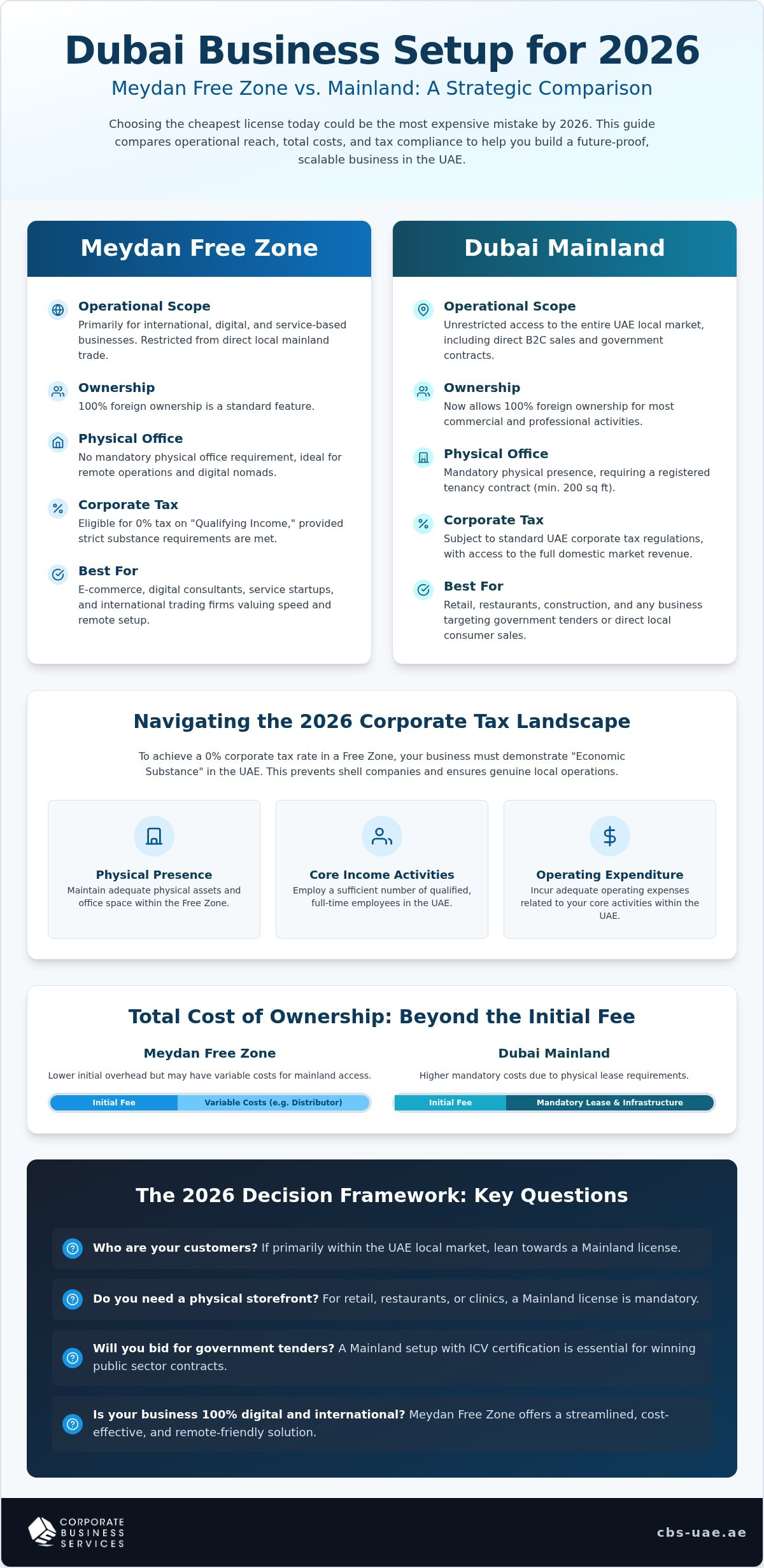
The legal framework for business in Dubai is built on two distinct pillars. Understanding the meydan free zone vs mainland choice begins with the regulator. Free zones are self-governed economic hubs, while Mainland companies register directly with the Department of Economy and Tourism (DET). By 2026, the gap in ownership has closed significantly. Almost all commercial activities now allow 100% foreign ownership on the Mainland, removing the old requirement for a local partner in most sectors. This shift means your decision shouldn’t be based on who owns the shares, but on where your customers are located.
As your navigator in this complex environment, we see many investors fall into the trap of choosing the lowest entry price without considering operational limits. Meydan has emerged as a powerhouse for service startups because it bridges the gap between a traditional free zone and the city’s commercial heart. However, a Mainland license remains the “gold standard” for those who need to trade directly with the public or bid on massive infrastructure projects. Selecting the wrong jurisdiction can lead to banking delays or fines if you operate outside your permitted zone.
What is the Meydan Free Zone Advantage?
Meydan has carved a specific niche as a digital-first jurisdiction. It’s one of the most efficient Dubai free zones for entrepreneurs who value speed and technology. It’s particularly popular for e-commerce and professional consultants because of its “Meydan Pay” ecosystem. This digital solution helps international founders bypass the traditional hurdles of corporate banking, which is often a major pain point for new entities. Since the setup is entirely remote, UK-based and international investors can secure their license without stepping foot in the UAE, making it a frictionless entry point for the 2026 market.
The Strategic Power of a Dubai Mainland License
Mainland is about scale and total market freedom. If your 2026 business plan involves opening a physical retail shop, a restaurant, or providing services to government departments, a Mainland license is mandatory. It grants you unrestricted access to the entire UAE domestic market. Unlike free zone entities that may face restrictions when trading outside their zone, Mainland companies can establish offices anywhere in the Emirates. This setup is also essential for companies looking to secure lucrative semi-government contracts, where a local Mainland presence is often a prerequisite for the bidding process.
Operational Scope and Market Access Restrictions
The choice between meydan free zone vs mainland often boils down to a single question: who is your end customer? If you’re selling directly to consumers (B2C) in a physical shop or bidding for government tenders, the Mainland is your only viable path. Conversely, digital nomads and service-based consultants often find the free zone model more aligned with their lean operational style. It’s about matching your license to your 2026 revenue streams.
Mainland entities must maintain a physical presence. As of 2026, this means a registered tenancy contract for a space of at least 200 square feet. This isn’t just a regulatory hurdle; it’s a strategic asset that allows you to trade anywhere in the UAE without a middleman. For those managing complex documentation across jurisdictions, partnering with expert PRO services ensures that your local permits and labor files remain compliant with the latest standards.
Local Trading and Government Tenders
Mainland licenses are the gateway to the UAE’s public sector. To win large-scale contracts, companies often need to demonstrate “In-Country Value” (ICV), a certification that tracks your contribution to the local economy. A Mainland setup makes this process much simpler. It also allows you to branch out into other Emirates like Abu Dhabi or Sharjah under the same legal umbrella. If your business model relies on “on-the-ground” physical services, such as construction or local retail, the Mainland’s unrestricted access is non-negotiable.
International Reach and Digital Business
Meydan Free Zone is designed for the modern, borderless entrepreneur. It provides an optimized framework for cross-border digital services and international trade. While free zone entities are technically restricted from direct mainland trade, Meydan companies can navigate this by using mainland-based distributors or obtaining specific permits from the Dubai Department of Economy and Tourism (DET). This flexibility is a major advantage for service providers who don’t need a storefront.
For e-commerce founders, the logistics are slightly different. You might store goods in a Free Zone warehouse but use a third-party logistics (3PL) provider on the mainland to handle last-mile delivery. This hybrid approach keeps overheads low while maintaining a wide reach. If you’re unsure which path fits your logistics chain, our team can provide tailored PRO support to map out your best route. Service-based consultants frequently choose Meydan because it offers a professional image without the immediate need for a physical office lease, allowing for a much faster ROI in the first year.
Comparing Setup Costs, Infrastructure, and Timelines
When you evaluate the financial commitment of a meydan free zone vs mainland setup, you’re looking at two very different capital allocation strategies. Meydan is built for those who want to minimize upfront risk, offering a low-barrier entry point that favors digital-first operations. On the other hand, the Mainland requires a more substantial initial investment, primarily due to mandatory physical infrastructure. It’s vital to view these not just as costs, but as investments in your specific 2026 market strategy.
The timeline for getting your business off the ground also varies significantly between these jurisdictions. Meydan is known for its “Fawri” or instant license options, which can often be processed within the same day for standard activities. Mainland registration follows the Department of Economy and Tourism (DET) approval cycles. While this process is highly streamlined, it typically takes a few business days as it involves external approvals and the registration of a physical lease. Understanding the mainland company formation process is essential if your goals involve immediate local trade and physical presence.
Meydan’s Cost-Effective Digital Setup
Meydan Free Zone offers a unique “Easy Pay” structure and multi-year license discounts that are particularly attractive for startups in 2026. By opting for a multi-year package, you can lock in current rates and protect your business from future fee adjustments. The biggest cost saver here is the lack of a physical office requirement. You can operate using a flexi-desk or a virtual address, which removes the burden of utility bills, maintenance, and security deposits. If you’re a solo founder, you’ll find that visa allocations are bundled into transparent packages, making it easier to forecast your first year of spending without hidden surprises.
Mainland Physical Infrastructure Requirements
The Mainland setup is inseparable from physical real estate. Every Mainland license must be linked to an Ejari (a registered tenancy contract). This is often where the “hidden” costs of Mainland setup reside, as you’ll need to account for annual rent, office fit-outs, and administrative fees. However, this infrastructure is what dictates your growth capacity. In the Mainland, your visa quota is directly tied to the square footage of your office. As you grow and lease larger spaces, your ability to hire staff scales automatically. For many expanding firms, these costs stabilize over time, providing a more sustainable foundation for a high-headcount business compared to the per-visa fee structures often found in free zones.
Visa Quotas and Corporate Compliance in 2026
The administrative side of your business requires a forward-looking strategy, especially when comparing the meydan free zone vs mainland choice for 2026 residency. The logic for hiring staff differs significantly between these two paths. Meydan simplifies the process by offering fixed visa packages, typically ranging from one to six visas depending on your license tier. This predictability is excellent for lean startups. Conversely, Mainland quotas are strictly tied to physical real estate. You’ll generally receive one visa allocation for every 80 to 100 square feet of office space. If you’re planning to scale a large team quickly, the Mainland’s office-based model offers more long-term flexibility.
Staying compliant isn’t just about visas. The 2026 regulatory environment demands meticulous record-keeping. Whether you choose a free zone or the mainland, professional accounting and bookkeeping is no longer optional. It’s the foundation for proving your business substance and managing tax filings.
Golden Visa Eligibility and Residency
The UAE Golden Visa has become a central goal for many international investors. In the Meydan environment, your path to this 10-year residency often hinges on the scale of your investment and professional category. On the Mainland, the advantage lies in the ease of sponsoring large teams and multiple family dependents. As an authoritative navigator in this space, we recommend securing your residency early to lock in the stability that a long-term visa provides. This move protects your personal status from the fluctuations of business license renewals.
Corporate Tax and Financial Advisory
The biggest shift for 2026 is the maturity of the UAE corporate tax regime. The meydan free zone vs mainland tax implications are a primary concern for new founders. Mainland companies face a standard 9% tax on profits exceeding AED 375,000. In the Meydan Free Zone, you might be eligible for a 0% rate, but only if your revenue is classified as “Qualifying Income.” This distinction is complex. For example, income from distributing goods now requires an independent auditor’s report to verify eligibility.
Failing to distinguish between qualifying and non-qualifying income can lead to unexpected tax liabilities. Seeking early corporate tax advisory is the most effective way to prevent expensive penalties and ensure your 2026 filings are airtight. Our team can help you map out a tax-efficient structure before your first fiscal year-end.
The 2026 Decision Framework: Which Setup Wins?
Choosing between meydan free zone vs mainland is the final, most critical step in your Dubai market entry strategy. By this stage, you’ve seen how setup costs and visa regulations diverge. The dubai free zone vs mainland debate for 2026 is no longer about who owns the shares; it’s about where your revenue is generated and how you intend to scale your physical footprint. The “winner” is simply the jurisdiction that removes the most friction from your specific business model.
If your 2026 goals involve a lean, tech-driven operation, Meydan offers a path of least resistance. However, if you’re building a business that relies on the UAE’s physical infrastructure, a Mainland license is a non-negotiable requirement. It’s also worth considering the hybrid approach. Thanks to the legal framework established in October 2025, companies can now migrate their registration between a free zone and the mainland without liquidating the entity. This allows you to start lean in Meydan and transition to Mainland as your local market share grows.
When Meydan Free Zone is the Optimal Choice
Meydan is the 2026 champion for solopreneurs, digital nomads, and pure e-commerce players. If your business can be managed from a laptop and your clients are primarily international, the low overhead of a virtual office is a massive advantage. Tech startups often choose this route because of the speed of the “Fawri” license and the ability to manage everything remotely. The key trigger for choosing Meydan is a need for immediate market entry with minimal capital tied up in physical real estate or security deposits.
Why Your Business Might Require a Mainland License
Your business requires a Mainland license if your 2026 success depends on being a “local insider.” This setup is essential for logistics firms, retail chains, construction companies, and any service provider targeting government contracts. The ability to sell directly to consumers (B2C) anywhere in the Emirates provides a scalability that free zones cannot match. While the initial investment is higher, the “Mainland advantage” lies in the unrestricted access to the domestic market and the ability to sponsor a large workforce based on your office square footage.
Before you commit to either path, use this final checklist to align your decision with your long-term vision:
- Revenue Source: Is more than 70% of your income coming from outside the UAE? (Meydan)
- Physical Footprint: Do you need a storefront or a warehouse on the mainland? (Mainland)
- Contract Type: Will you be bidding for semi-government or public sector tenders? (Mainland)
- Team Size: Do you plan to hire more than six employees in your first year? (Mainland)
- Tax Compliance: Does your income meet the “Qualifying” criteria for free zone exemptions? (Meydan)
As your authoritative navigator, we’re here to ensure your choice is future-proof. Whether you’re launching a consulting firm or a regional logistics hub, we’ll help you secure a license that grows with you through 2026 and beyond.
Future-Proofing Your Dubai Business Strategy for 2026
Navigating the meydan free zone vs mainland decision requires looking beyond the initial setup fees to your long-term operational goals. Whether you prioritize the lean, digital-first efficiency of Meydan or the unrestricted local market reach of a Mainland license, your setup must be built for 2026 compliance. Success in this evolving landscape depends on mastering new corporate tax substance requirements and securing reliable banking partners from day one. Choosing the wrong jurisdiction now can lead to restrictive market access or unexpected tax liabilities as your revenue grows.
As a 100% Emirati-owned consultancy, we provide the direct government relations and local mastery needed to simplify these complex administrative tasks. Our team offers award-winning corporate tax advisory to ensure you meet 2026 standards, alongside comprehensive bank account opening support included with your formation. We act as your authoritative navigator, protecting your interests while accelerating your growth in the UAE.
Consult with our Emirati-owned experts to secure your 2026 Dubai setup and begin your journey with the confidence of having a seasoned partner by your side. Your success is our priority, and we’re ready to help you build a legacy in Dubai.
Frequently Asked Questions
Can a Meydan Free Zone company trade directly with customers in Dubai Mainland?
No, a Meydan Free Zone entity cannot trade directly with customers on the mainland without a distributor or a specific permit. While free zones are designed for international and intra-zone trade, the Dubai Department of Economy and Tourism (DET) allows certain activities to access the local market through official permits. If your primary goal is direct B2C sales to the local public, a mainland setup is the superior choice for your business goals.
Is a physical office mandatory for a Dubai Mainland company in 2026?
Yes, a physical office is mandatory for all mainland companies as of 2026. You must maintain a dedicated space of at least 200 square feet and possess a registered Ejari tenancy contract. This requirement is a core part of the mainland licensing process and dictates your total visa quota. Unlike the virtual office options available in free zones, the mainland model prioritizes a physical presence within the local economy to support growth and compliance.
What are the corporate tax implications for a Meydan Free Zone entity?
Meydan entities can qualify for a 0% corporate tax rate on their Qualifying Income provided they meet specific substance requirements. However, any income that doesn’t meet these criteria is taxed at the standard 9% rate for profits exceeding AED 375,000. For the 2026 tax period, businesses must maintain audited financial statements and adequate substance within the zone. Navigating these rules requires professional advisory to ensure you don’t lose your tax-free status.
How many visas can I get with a Meydan Free Zone license?
Your visa allocation in Meydan depends on the specific license package you select during setup. Most standard tiers offer between one and six visas, which is ideal for small teams or solo founders. Unlike the mainland, where quotas scale based on the square footage of your leased office, Meydan provides fixed, transparent packages. This makes it easier for international investors to forecast their initial overheads and administrative costs without leasing physical real estate.
Can I open a corporate bank account in the UAE with a Meydan license?
Yes, you can open a corporate bank account with a Meydan license, though the process requires thorough documentation. Meydan offers the Meydan Pay ecosystem to help digital entrepreneurs bridge the gap between registration and traditional banking. While many free zone entities face increased scrutiny from local banks, our bank account opening support ensures that your application is prepared meticulously. This reduces the friction often associated with securing a corporate account for a new entity.
Which setup is faster for an international investor from the UK?
Meydan Free Zone is generally the faster option for UK investors due to its fully digital Fawri instant license process. You can often secure your license in under an hour without being physically present in the UAE. While mainland registration is also highly efficient, it involves additional steps like registering a physical lease and obtaining DET approvals. If speed and remote management are your primary concerns, the meydan free zone vs mainland comparison favors the free zone.
Do I need a local UAE partner for a Mainland company in 2026?
No, you don’t need a local UAE partner for most business activities on the mainland in 2026. Recent regulatory changes have expanded 100% foreign ownership to the vast majority of commercial and professional sectors. This leveled the playing field for international investors who previously chose free zones solely for ownership reasons. You can now maintain full control of your mainland entity while enjoying unrestricted access to the entire domestic market and government contracts.
Can I upgrade from a Free Zone to a Mainland license later?
Yes, a legal framework established in October 2025 allows companies to migrate their registration from a free zone to the mainland. This means you don’t have to liquidate your original entity to change jurisdictions. It’s a strategic move for businesses that start lean in a free zone but eventually require a physical retail presence or the ability to bid on large government tenders. This flexibility ensures your business setup remains future-proof as your operations scale.