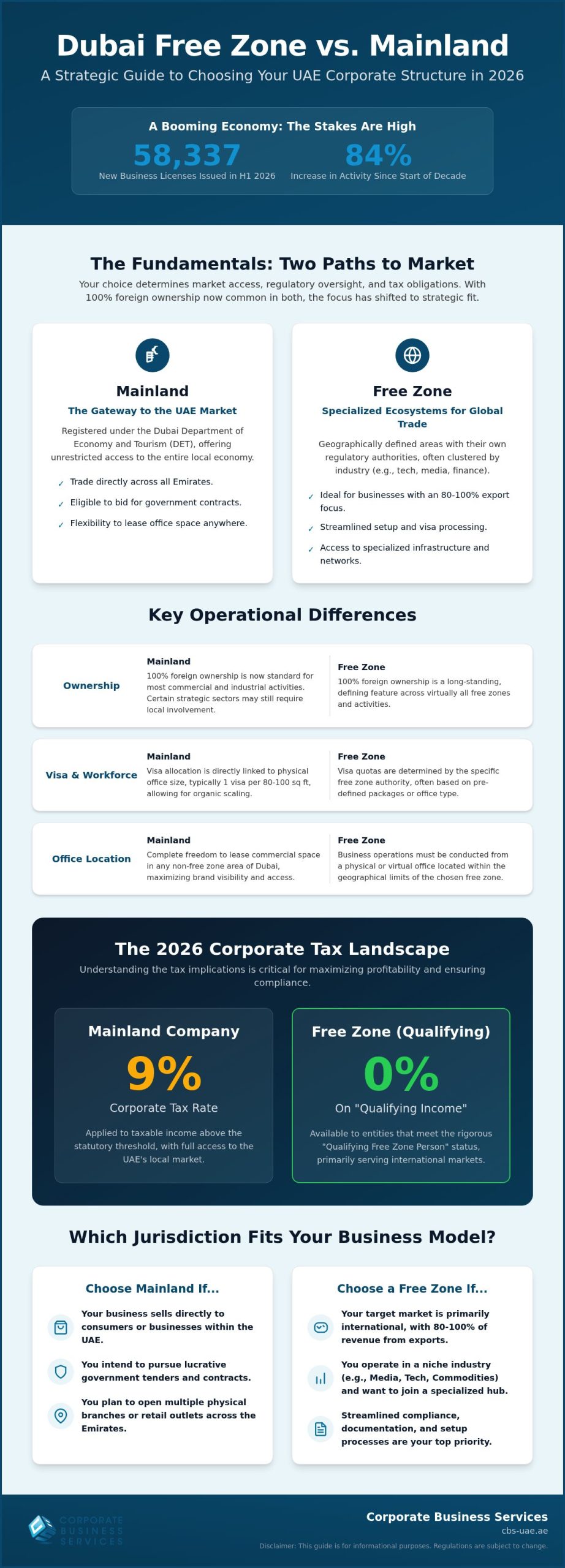
In the first half of 2026 alone, Dubai issued 58,337 new business licenses, marking a massive 84% increase in activity compared to the start of the decade. This surge highlights a booming economy, but it also underscores the high stakes of the dubai free zone vs mainland decision. You aren’t just choosing a location; you’re selecting a regulatory framework that determines your market access and tax obligations for years to come.
It’s understandable if the transition to a formal corporate tax regime feels overwhelming. You want to ensure you’re maximizing your 0% “Qualifying Income” potential without accidentally boxing yourself out of lucrative government contracts or local trade. We’ve designed this guide to replace that anxiety with a clear, strategic roadmap. You’ll discover exactly how the 2026 tax laws apply to your specific model and how the latest 100% foreign ownership rules have leveled the playing field for international investors.
We’ll break down the critical operational differences, compare registration timelines, and explore the “Qualifying Free Zone Person” status in detail. By the end, you’ll have a definitive decision framework to launch your venture with total confidence and zero friction.
Key Takeaways
- Define the core legal differences between DET-registered Mainland entities and geographically specific Free Zone authorities to establish a solid corporate foundation.
- Navigate the 2026 tax landscape by understanding the 9% Mainland threshold and the rigorous compliance needed for the 0% Qualifying Free Zone Person status.
- Evaluate the operational impact of your choice in the dubai free zone vs mainland debate, focusing on visa scalability and mandatory office space requirements.
- Align your specific industry needs, such as local e-commerce delivery or professional consultancy, with the jurisdiction that offers the greatest strategic advantage.
- Streamline your entry into the UAE market with a comprehensive setup process that integrates government documentation, PRO services, and financial compliance.
The Fundamentals: Defining Dubai Free Zone and Mainland in 2026
The choice between Mainland and Free Zone determines your geographic trade limits and regulatory oversight. In the past, this decision was largely driven by ownership rules. Today, the 2026 business environment has shifted. Following recent amendments to the UAE Commercial Companies Law, 100% foreign ownership is now standard for most commercial activities on the mainland. This means the dubai free zone vs mainland comparison now focuses on your target market and operational scale rather than who owns the shares. It’s a strategic pivot that allows you to prioritize growth over legal workarounds.
Mainland: The Gateway to the UAE Market
A mainland company is a legal entity registered under the Dubai Department of Economy and Tourism (DET). It’s the most versatile structure for entrepreneurs who want to penetrate the local economy. If your business model relies on selling directly to consumers in Dubai, bidding for government tenders, or opening multiple branches across the Emirates, the mainland is your home. You don’t need a local partner for most activities, which simplifies your corporate governance significantly and places the control of your venture firmly in your hands.
There are no geographic restrictions on where you can lease an office. You’re free to choose any commercial area that suits your brand and operational needs. This flexibility is vital for businesses that require high visibility or proximity to specific logistics hubs. Mainland entities also enjoy unrestricted trade with both local and international markets, making them a robust choice for long-term expansion within the region. This setup is particularly effective for businesses that plan to scale their physical presence as they grow.
Free Zones: Specialized Ecosystems for Global Trade
Free zones are geographically defined areas, each governed by its own independent regulatory authority. There are over 40 distinct free trade zones in the UAE, many of which are designed as industry-specific clusters. Whether you’re in fintech, media, or heavy industry, there’s likely a zone tailored to your niche that offers a community of like-minded professionals and specialized infrastructure.
These jurisdictions offer a frictionless setup process and customized regulations that cater to international trade. They’re ideal for businesses with an 80-100% export focus. While free zone companies are generally restricted from trading directly with the UAE mainland without a distributor or a mainland branch, they provide a highly efficient base for global operations. The dubai free zone vs mainland choice for these businesses often comes down to the specific incentives offered by the zone authority. This includes streamlined visa processing for international staff and potential tax advantages that we’ll explore in the following sections.
Key Operational Differences: Ownership, Visas, and Scope
The operational mechanics of a dubai free zone vs mainland entity diverge most sharply when you look at your team’s growth potential. While both now offer 100% foreign ownership for the vast majority of activities, the way you scale your workforce and secure your physical presence follows very different rules. Choosing the wrong structure early on can lead to restrictive bottlenecks as your business expands.
Foreign Ownership Myths vs. Reality
Many investors still believe that Mainland companies require a local partner holding 51% of the shares. This hasn’t been the case for most commercial and industrial activities since the 2021 Commercial Companies Law amendments. In 2026, 100% foreign ownership is the standard. However, certain “strategic impact” sectors, such as defense or banking, still require local involvement. For professional licenses, you might still need a Local Service Agent (LSA) to facilitate government documentation, but they hold no equity in your business. Partnering with an Emirati-owned consultancy like CBS provides an insider’s advantage, ensuring your corporate structure is compliant and future-proof from day one.
Visa and Workforce Management
Mainland entities offer a direct correlation between physical office size and visa capacity. Typically, the authorities grant one visa for every 80 to 100 square feet of leased office space. This allows for organic growth; as you lease more space, your visa quota expands. In contrast, Free Zones often operate on tiered packages. A “flexi-desk” or virtual office setup might limit you to just two or three visas. If you plan to hire a large team quickly, the Mainland’s scalability is often more predictable and cost-effective. You can also integrate a UAE Golden Visa application into your long-term strategy to secure long-term residency for key stakeholders and high-level talent.
The scope of your license also dictates your daily operations. Professional licenses are designed for service-based businesses like consultancies, while Commercial licenses are required for trading. Managing the transition between these license types or handling the volume of government paperwork can be daunting. Our PRO services in Dubai handle the heavy lifting of government documentation, ensuring your setup remains frictionless while you focus on your core business objectives. Whether you need physical office space mandates or specialized activity approvals, having an authoritative navigator makes the process seamless.
The 2026 Tax Landscape: Navigating Corporate Tax and Compliance
The introduction of Federal Decree-Law No. 47 of 2022 fundamentally changed the dubai free zone vs mainland equation. While the UAE remains a highly competitive tax environment, the era of zero-tax-by-default has been replaced by a nuanced, compliance-driven framework. For mainland companies, the math is straightforward: a 0% rate applies to taxable income up to AED 375,000, with a 9% rate on everything above that. This clear threshold allows small to medium-sized enterprises to forecast their liabilities with precision.
Free Zone entities face a more complex set of criteria to maintain their tax advantages. To qualify as a “Qualifying Free Zone Person” (QFZP) and retain a 0% rate on “Qualifying Income,” businesses must satisfy strict requirements. You must maintain adequate substance within the UAE, comply with transfer pricing rules, and ensure your non-qualifying revenue doesn’t exceed the de minimis threshold of 5% of total revenue or AED 5 million, whichever is lower. Failing to meet even one of these pillars can trigger the standard 9% rate on your entire income for that tax period.
Tax Treatment Comparison
Mainland companies are taxed on their total domestic and international taxable income once they cross the AED 375,000 mark. This setup is often simpler for those focusing on the local market. In contrast, Free Zone companies deal with a bifurcated system where only specific activities qualify for the 0% rate. For UK investors looking to optimize their global tax footprint, professional corporate tax advisory uae is essential to avoid double taxation and ensure your structure aligns with both local laws and international OECD standards.
Compliance and Reporting Standards
Regardless of your jurisdiction, every business must register for Corporate Tax. This isn’t optional. In 2026, the Federal Tax Authority (FTA) requires standardized accounting and bookkeeping. If you’re aiming for QFZP status, you’re also mandated to prepare audited financial statements. Startups should note that Small Business Relief remains available for tax periods ending on or before December 31, 2026, for businesses with revenue below AED 3 million. This relief allows eligible entities to be treated as having no taxable income, providing a critical buffer during the early growth phase. Proactive financial management isn’t just about avoiding penalties; it’s about building a transparent, bankable business that’s ready for institutional scaling.
Strategic Selection: Matching Your Business Model to a Jurisdiction
Your business model is the ultimate compass in the dubai free zone vs mainland decision. While the legal and tax frameworks provide the boundaries, your daily operations and target audience define which jurisdiction will actually fuel your growth. In 2026, the UAE’s digital-first economy rewards those who align their corporate structure with their primary revenue streams. Choosing the wrong foundation can lead to logistical hurdles that are far more expensive than the initial setup costs.
For e-commerce ventures, the mainland is often the superior choice. It allows you to deliver goods directly to consumers across all seven emirates without the need for a third-party distributor. This direct-to-consumer model is vital for maintaining margins and controlling the customer experience. Similarly, for logistics and aviation firms, Dubai South free zone setup offers a specialized ecosystem near Al Maktoum International Airport, providing a massive advantage for global shipping and supply chain management.
Tech and crypto startups, however, often thrive in specialized clusters like DMCC or Hub71. these zones offer regulatory sandboxes and access to venture capital networks that are tailored for high-growth innovation. If your focus is purely on international markets, these industry-specific hubs provide a community of like-minded founders and specialized infrastructure that the mainland might not offer. Entrepreneurs considering DMCC specifically can benefit from reviewing a comprehensive DMCC company formation guide to understand the 2026 setup process, available business activities, and corporate tax implications unique to that zone.
Service-Based vs. Trading Companies
The choice often hinges on where your clients sit. If you’re launching a consultancy targeting UAE government entities or large local corporations, a Professional License on the mainland is essential. It provides the prestige and legal standing required to bid on domestic contracts. If your consulting work is 100% international, the streamlined efficiency of a Free Zone might be more attractive. You’ll benefit from industry-specific regulations while maintaining a base in a global business hub.
The Hybrid Approach
Mature enterprises often find that a single jurisdiction isn’t enough. Many choose to set up a Free Zone entity for global operations while maintaining a Mainland branch to capture local market share. This hybrid strategy is also a powerful way to future-proof your business for regional expansion into Saudi Arabia. By establishing a robust UAE presence first, you create a credible platform for entering the wider GCC market. If you’re leaning toward a domestic focus, our guide on Mainland Company Formation in Dubai: The Complete 2026 Strategic Guide explores these domestic advantages in greater detail.
If you’re still weighing the pros and cons of each jurisdiction for your specific industry, our team can provide a tailored roadmap for your business setup in Dubai Free Zone or Mainland to ensure your structure matches your ambition.
Seamless Transition: How CBS Facilitates Your Dubai Business Setup
Choosing between a dubai free zone vs mainland setup is a high-stakes strategic hurdle, but the administrative execution is often where founders feel the most pressure. We don’t just provide high-level advice; we act as your dedicated local partner to ensure your vision doesn’t get lost in translation. As an Emirati-owned consultancy, we possess the deep-rooted insight required to bypass common bureaucratic delays. We understand the nuances of government documentation that can be invisible to outsiders, providing you with a clear path through a maturing regulatory market.
For international entrepreneurs, especially those looking to setup company in dubai from uk, the distance can make the process feel opaque. We bridge that gap by managing every touchpoint with the authorities. In the first half of 2026, Dubai saw over 173,000 license renewals, proving that while the market is growing, the demand for efficient compliance management is higher than ever. Our role is to ensure your business is part of that success story without the typical setup friction.
Our One-Stop Facilitation Model
We’ve built a holistic service ecosystem designed to reduce administrative friction. You shouldn’t have to juggle multiple vendors for your license, your visa, and your financial compliance. Our one-stop model integrates every essential service into a single, orderly journey. This includes:
- Expert PRO Services: We handle all government documentation and liaison with the DET or Free Zone authorities for rapid approvals.
- Financial Foundation: From bank account opening support to corporate tax registration, we ensure your fiscal structure is compliant with 2026 standards.
- Strategic Mentorship: You’ll receive personalized guidance from seasoned corporate mentors who understand the local landscape.
Next Steps for Your Dubai Expansion
Your journey begins with a detailed feasibility study. We analyze your business model to confirm whether a Free Zone or Mainland structure offers the best long-term ROI. Once the jurisdiction is settled, we take over the heavy lifting of document preparation and government submission. This methodical approach ensures that your application is right the first time, preventing costly revisions or delays.
Post-incorporation, we don’t just hand over the keys. We provide ongoing support to manage your accounting, bookkeeping, and annual license renewals. This proactive compliance management is essential in 2026 to maintain your “Qualifying” status for tax purposes or to scale your visa quota as your team grows. We’re here to be your authoritative navigator, ensuring your transition into the UAE market is as seamless as it is successful.
Launch Your Dubai Venture With Strategic Certainty
The decision regarding dubai free zone vs mainland is no longer just a legal formality; it’s a strategic choice that dictates your company’s growth trajectory in a maturing economy. By now, you should have a clearer understanding of how market access, visa scalability, and the 2026 tax framework align with your specific industry goals. Whether you prioritize the domestic reach of the mainland or the specialized clusters of a free zone, your foundation must be built on total regulatory compliance.
As an Emirati-owned consultancy, CBS acts as your authoritative navigator through this complex landscape. We provide a comprehensive one-stop-shop for all corporate needs, from initial feasibility studies to bank account opening support. Our proven track record with international investors ensures that your transition into the UAE market is frictionless and efficient. Don’t leave your corporate structure to chance.
Book a Consultation with CBS Experts Today to finalize your roadmap. We’re ready to help you turn these strategic insights into a thriving Dubai presence.
Frequently Asked Questions
Can a Free Zone company trade directly with Mainland UAE customers?
Free Zone companies are primarily restricted to international trade or business within their specific zone. To trade directly with customers on the UAE mainland, you typically need to appoint a local distributor or establish a separate mainland branch. This distinction is a core factor in the dubai free zone vs mainland decision for trading businesses. Understanding these geographic boundaries ensures your commercial activities remain compliant with the latest 2026 regulations.
Is 100% foreign ownership available for all business activities in Mainland Dubai?
Full foreign ownership is now permitted for the vast majority of commercial and industrial activities on the mainland. However, a “negative list” of strategic sectors still requires a local partner. These exceptions include activities related to security, defense, banking, and telecommunications. It’s essential to verify your specific business activity against the latest DET guidelines to confirm if you can retain 100% control of your mainland entity without local equity participation.
Which setup is more cost-effective for a solo entrepreneur in 2026?
For solo entrepreneurs, a Free Zone setup often provides a more cost-effective entry point due to lower initial registration fees and streamlined licensing packages. These zones frequently offer virtual office or “flexi-desk” solutions that minimize overhead costs. While mainland licenses are becoming increasingly competitive, they often involve additional costs related to physical office mandates and external approvals, which might be unnecessary for a single-person consultancy or digital service provider during the initial launch phase.
Do I need a physical office to get a business license in Dubai?
Yes, a physical office address is a mandatory requirement for obtaining a business license, though the type of space varies by jurisdiction. Mainland companies must typically register a physical lease, which also determines their employee visa quota. Many Free Zones offer flexible alternatives like “flexi-desks” or “smart offices,” which satisfy the legal requirement for a physical presence while providing a more agile solution for startups and remote-first businesses that don’t require traditional corporate premises.
How does the 9% UAE Corporate Tax affect Free Zone companies?
Free Zone companies can maintain a 0% corporate tax rate on “Qualifying Income” provided they meet the criteria for a “Qualifying Free Zone Person.” This includes maintaining adequate substance and preparing audited financial statements. Any income that doesn’t meet these specific definitions, or income earned from non-qualifying activities, is subject to the standard 9% tax rate once it exceeds the AED 375,000 threshold. Navigating these nuances is the most critical part of the current dubai free zone vs mainland tax strategy.
Can I switch my business from a Free Zone to Mainland later?
Recent regulatory updates have made it significantly easier for companies to transition between jurisdictions without liquidating their existing entity. This flexibility allows you to start in a Free Zone to test the market and later migrate to a Mainland license as your domestic trade requirements grow. We facilitate this transition by managing the necessary government documentation and ensuring your corporate history remains intact throughout the administrative shift, providing a frictionless path for your expanding operations.
What are the visa advantages of a Mainland setup for large teams?
Mainland setups offer superior scalability for businesses planning to hire large teams. Unlike Free Zones, which often have fixed visa blocks based on your license package, Mainland visa quotas are directly linked to the size of your physical office space. This allows you to increase your workforce organically by simply expanding your premises. It’s an ideal structure for labor-intensive industries or rapidly growing corporate headquarters that require a high volume of employment visas to support their regional growth.
How long does it typically take to complete business registration in Dubai?
The timeline for business registration depends heavily on your chosen jurisdiction and activity. Free zone company formation is generally faster, with many setups completed within 3 to 5 business days. Mainland registration typically takes longer, ranging from 2 to 6 weeks. This extended period is due to additional steps such as lease registration through Ejari and obtaining necessary external approvals from various government departments, depending on the complexity of your business model and specific industry requirements.