What if federal tax compliance isn’t an operational roadblock, but your organization’s sharpest competitive advantage? Across the national commercial market, the corporate tax impact on uae businesses has fundamentally altered executive priorities, transforming financial discipline from regulatory friction into a decisive commercial advantage. Yet adjusting to this framework brings understandable challenges. Untangling nuanced free zone qualification rules, modernizing bookkeeping practices to satisfy Federal Tax Authority standards, and avoiding an AED 10,000 late-registration penalty can easily leave even seasoned leaders feeling burdened by unexpected regulatory exposure.
You don’t have to approach these heightened compliance expectations with uncertainty or stress. In this strategic 2026 analysis, you’ll discover how federal corporate tax reshapes UAE business operations, compliance standards, and commercial profitability. Together, we’ll examine statutory income thresholds and small business relief, clarify essential transfer pricing benchmarks, and identify proactive governance pathways to protect your commercial margins while keeping your enterprise fully and seamlessly compliant.
Key Takeaways
- Evaluate the strategic corporate tax impact on uae businesses under Federal Decree-Law No. 47 of 2022, including core taxable thresholds and statutory relief mechanisms.
- Discover why upgrading internal bookkeeping systems to meet rigorous IFRS standards is vital for operational resilience and effortless tax filings.
- Clarify the strict compliance criteria and de minimis thresholds required for free zone enterprises to protect their preferential 0% tax status.
- Navigate mandatory transfer pricing regulations and documentation rules governing related-party arrangements and international commerce.
- Adopt a structured four-step governance roadmap on the EmaraTax portal to maintain continuous compliance and eliminate administrative penalties.
Understanding the Paradigm Shift: What Is the Corporate Tax Impact on UAE Businesses?
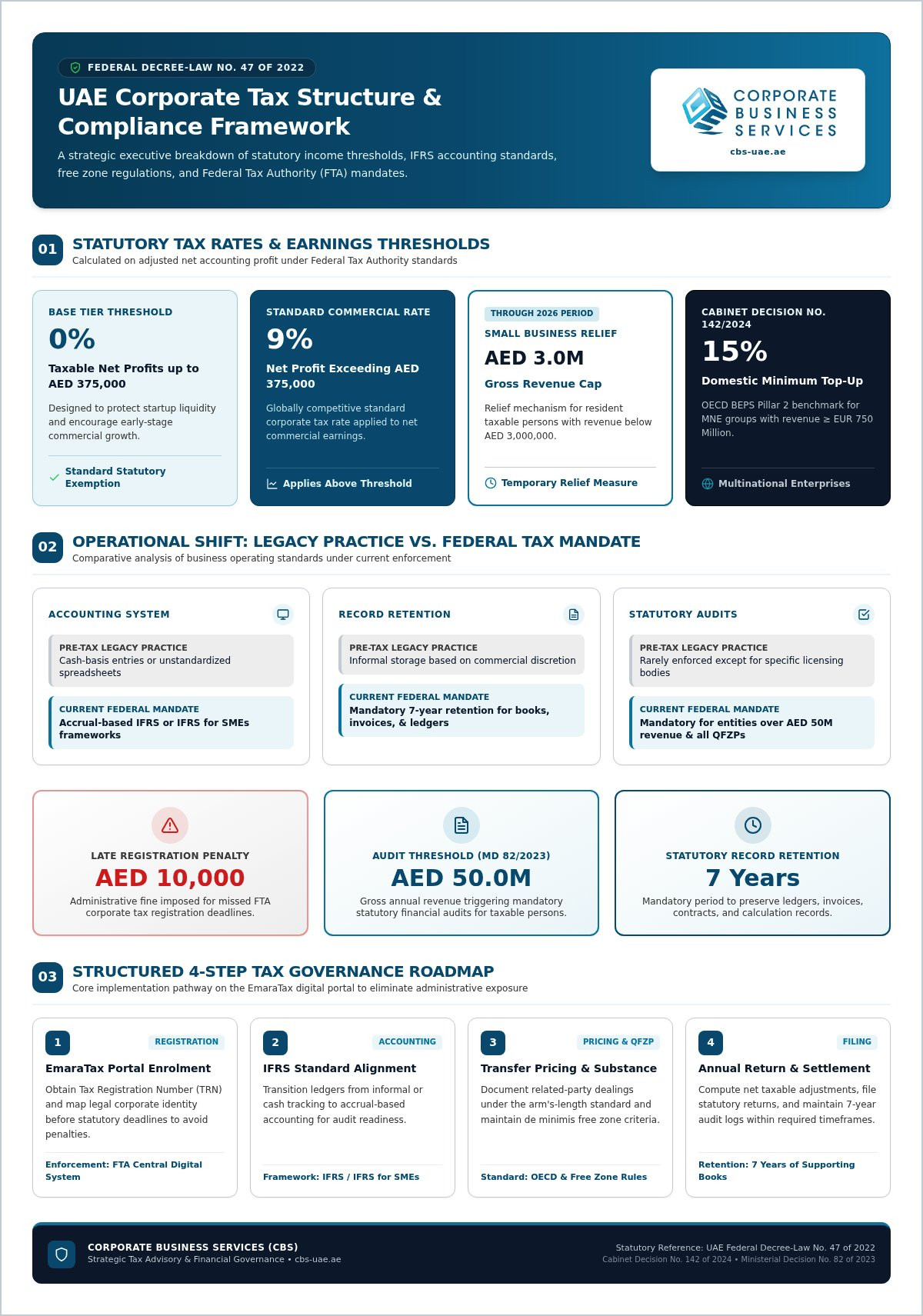
Federal Decree-Law No. 47 of 2022 fundamentally reshaped the nation’s commercial environment by introducing a direct federal tax on commercial earnings. Under this legal framework, taxable persons incur a 0% rate on taxable net profits up to AED 375,000, while net profit exceeding this statutory threshold faces a competitive standard rate of 9%. The corporate tax impact on uae businesses extends far beyond a routine balance-sheet liability; it redefines executive accountability, capital allocation, and long-term operating models. By reserving the 0% bracket for lower earnings and offering Small Business Relief for entities with gross revenues up to AED 3,000,000 through the 2026 tax period, the system protects startup liquidity while integrating mature enterprises into international fiscal conventions. Exploring the broader progression of taxation in the United Arab Emirates reveals how quickly the country has aligned domestic commerce with premier global governance practices.
Legislative Foundation and Scope of Federal Corporate Tax
Mandatory corporate tax liability encompasses all commercial entities incorporated nationwide, foreign juridical persons with a permanent establishment, and individuals conducting commercial activities. Corporate tax calculations center strictly on adjusted net accounting profit rather than gross revenue. Commercial teams must calculate allowable business deductions, non-deductible expenses, and statutory exemptions before establishing their taxable base. The Federal Tax Authority (FTA) acts as the sole national enforcement authority, overseeing registration, reviewing annual filings, and auditing corporate balance sheets through its centralized digital architecture.
Global Compliance Benchmarks and Economic Modernization
This statutory overhaul directly reflects the nation’s commitment to OECD Base Erosion and Profit Shifting (BEPS) measures. Under Cabinet Decision No. 142 of 2024, the UAE enacted the Domestic Minimum Top-Up Tax, applying an effective 15% rate on multinational enterprise groups with consolidated revenues reaching or exceeding EUR 750 million. Beyond statutory necessity, establishing rigorous accounting standards directly bolsters international banking relationships. Major financial institutions demand transparent, verifiable financial reports before extending commercial credit or onboarding cross-border accounts. Moving away from informal bookkeeping toward institutional financial governance ensures the corporate tax impact on uae businesses serves as a catalyst for sustainable, long-term commercial growth.
Operational Transformations: Financial Reporting, Auditing, and Bookkeeping Realities
Informal record-keeping is no longer an option under current federal regulations. The corporate tax impact on uae businesses requires every commercial entity to transition toward disciplined, accrual-based accounting governed by International Financial Reporting Standards (IFRS) or IFRS for SMEs. Under Ministerial Decision No. 82 of 2023, taxable persons crossing AED 50,000,000 in gross revenue must prepare statutory audited financial statements. Relying on professional accounting and bookkeeping structures ensures that business ledgers produce audit-ready computations, substantiating every commercial expense against statutory disallowances.
The operational divide between legacy practices and contemporary statutory requirements reflects a complete procedural transformation:
| Operational Area | Pre-Tax Commercial Practice | Current Federal Tax Mandate |
|---|---|---|
| Accounting Standards | Cash-basis entries or unstandardized spreadsheets | Accrual-based IFRS or IFRS for SMEs frameworks |
| Record Retention | Informal storage based on commercial discretion | Mandatory 7-year retention for books, invoices, and ledgers |
| Audit Requirements | Rarely enforced except for specific licensing bodies | Mandatory for entities over AED 50M revenue and all QFZPs |
| Expense Validation | Discretionary business and personal cost pooling | Strict limits on non-business deductions and entertainment caps |
Mandatory Financial Statements and IFRS Compliance
Standardized financial statements serve as the legal baseline for taxable profit calculations. Businesses must maintain verifiable books of accounts, invoices, agreements, and trial balances for a minimum of seven years. While mainland entities below the AED 50 million threshold avoid statutory corporate tax audits, their underlying ledgers must strictly align with published Federal Tax Authority Corporate Tax guidelines to withstand administrative reviews.
Digital Tax Infrastructure and System Integration
Modern enterprise resource planning platforms now represent essential infrastructure rather than discretionary software. Disconnected spreadsheets create unacceptable risks; spreadsheet typos, unvetted shareholder withdrawals, or unsegmented income streams can trigger scrutiny during digital reconciliations on the EmaraTax portal. Pairing modern ERP tools with proactive corporate advisory from cbs-uae.ae helps executives protect their commercial margins while maintaining frictionless compliance across every filing cycle.
Jurisdictional Distinctions: Free Zone Benefits Versus Mainland Tax Obligations
Operating within a free zone no longer guarantees an automatic exemption from federal corporate tax. The corporate tax impact on uae businesses is felt acutely in how geographic jurisdictions dictate statutory exposure. Mainland companies operate under a standard framework, paying 9% on taxable net profits exceeding the statutory AED 375,000 threshold. In contrast, free zone entities can access a 0% preferential rate exclusively on “Qualifying Income,” while any non-qualifying commercial earnings face the standard 9% rate starting from the very first dirham. Deciding between these models requires strategic evaluation, as detailed in our comparative guide on dubai free zone vs mainland licensing structures.
Maintaining Qualifying Free Zone Person (QFZP) Status
Safeguarding the 0% tax benefit requires strict adherence to Cabinet Decision No. 100 of 2023 and Ministerial Decision No. 229 of 2025. To maintain Qualifying Free Zone Person status, an enterprise must fulfill four core legal conditions:
- Maintain adequate economic substance, including resident qualified personnel and physical operating assets domestically.
- Derive income solely from qualifying activities or transactions conducted with other free zone persons.
- Prepare mandatory audited financial statements under IFRS or IFRS for SMEs, regardless of annual turnover.
- Comply fully with the de minimis threshold, ensuring non-qualifying revenue does not exceed the lower of 5% of total revenue or AED 5,000,000.
Breaching this de minimis threshold triggers an immediate disqualification. The company loses its preferential status for the current tax period and the subsequent four tax years, subjecting all corporate earnings to the 9% rate across that five-year window.
Commercial Transactions Between Free Zone and Mainland Entities
Intercompany commerce between dual jurisdictions demands rigorous structural alignment. When a free zone business supplies commercial services directly to mainland customers, that revenue generally qualifies as non-qualifying income. For physical goods distribution, a free zone entity must operate from a designated zone with customs controls to retain 0% eligibility; general free zone distribution to the mainland often fails this test. Additionally, payments made by mainland companies to related free zone entities face strict transfer pricing reviews and potential non-deductibility if they fail arm’s-length standards. Well-structured corporate groups frequently establish separate legal entities, isolating mainland commercial operations from core export and international trading entities to shield consolidated profit margins.
International Commerce, Transfer Pricing, and Cross-Border Considerations
Global trade arrangements now face unprecedented scrutiny as cross-border intercompany transactions undergo formal fiscal examination. The corporate tax impact on uae businesses operating across international borders centers on demonstrating genuine commercial substance rather than procedural convenience. Under federal guidelines, transactions between foreign parent entities and domestic subsidiaries must strictly reflect fair market value under the arm’s length principle. This standard prevents arbitrary profit shifting, while an extensive network of bilateral double taxation avoidance treaties protects international investors against duplicative taxation on foreign earnings.
Transfer Pricing Documentation and the Arm’s Length Principle
Federal Decree-Law No. 47 of 2022 defines related parties through corporate shareholding, voting control, or direct kinship. It also enforces strict controls on connected persons, such as company founders, directors, and key executives. Commercial groups must file a Transfer Pricing Disclosure Form alongside their tax return on the EmaraTax portal when aggregate related-party transactions exceed AED 40,000,000, or when payments to connected persons surpass AED 500,000 in a single tax period.
Under Ministerial Decision No. 97 of 2023, businesses must prepare and maintain both a Local File and a Master File if they meet statutory criteria:
- The entity generates standalone gross annual revenue of AED 200,000,000 or more.
- The entity belongs to a multinational group with consolidated revenues of AED 3,150,000,000 or more.
Taxpayers have exactly 30 days to submit these records upon receiving an official FTA disclosure notice. Failing to substantiate intercompany service charges, intellectual property fees, or cross-border management costs invites swift administrative adjustments, converting disputed operational deductions back into taxable income.
Optimizing International Operations and Foreign Tax Credits
Foreign tax credits offer an effective mechanism to eliminate double taxation on overseas operations. When an enterprise pays income tax in a foreign jurisdiction on international commercial earnings, it can credit those amounts directly against its domestic corporate tax liability, capped at the domestic tax attributable to that specific income. For enterprises coordinating regional trade networks, such as establishing a business setup in Saudi Arabia, synchronizing intra-group pricing models across both national borders is essential to eliminate double corporate tax exposure. Schedule a tax structuring consultation with CBS to align your international operating agreements and safeguard group profit margins.
Building a Resilient Tax Roadmap: Long-Term Governance and Advisory Integration
Mastering the corporate tax impact on uae businesses requires replacing reactive adjustments with an institutional compliance framework. A common misconception persists that qualifying for Small Business Relief relieves an enterprise from all statutory obligations. Even if your gross annual revenue remains below AED 3,000,000, your business must register with the Federal Tax Authority, keep accurate books of accounts, and submit an annual corporate tax return electing for relief. Missing formal deadlines can lead to an immediate AED 10,000 administrative fine under Cabinet Decision No. 10 of 2024. Integrating dedicated corporate tax advisory UAE services provides the structural clarity needed to navigate statutory milestones without administrative friction.
Essential Steps for Complete Corporate Tax Readiness
Achieving total compliance across the national market requires a systematic, four-part operational roadmap:
- Step 1: Obtain a Corporate Tax Registration Number: Secure your Corporate Tax Registration Number (CTRN) via the EmaraTax digital platform within the statutory deadlines designated for your entity type.
- Step 2: Conduct an Internal Accounting Gap Analysis: Review your chart of accounts to ensure expenses, owner distributions, and personal drawdowns are strictly categorized under IFRS or IFRS for SMEs guidelines.
- Step 3: Document Intercompany Transactions: Draft explicit, arm’s length intercompany contracts and formal board resolutions for all related-party transactions, management fees, and connected-person remuneration.
- Step 4: Establish Scheduled Tax Provisioning: Calculate quarterly tax provisions directly within your accounting software to preserve operational cash flow well ahead of the annual nine-month filing deadline.
Securing Professional Advisory and Institutional Oversight
Proactive oversight transforms complex regulatory mandates into reliable operational habits. Partnering with an established, Emirati-owned advisory firm provides direct access to deep regulatory mastery, ensuring your commercial filings, transfer pricing documentation, and corporate structures remain fully insulated against administrative penalties. You don’t have to navigate intricate FTA mandates in isolation. Take action today to explore strategic corporate tax solutions and build lasting commercial resilience for your enterprise.
Transforming Corporate Tax Compliance into Commercial Opportunity
Managing the corporate tax impact on uae businesses is no longer just an administrative exercise; it’s a strategic pillar of operational excellence. Navigating this mature fiscal environment demands disciplined IFRS-aligned financial reporting, meticulous oversight of free zone qualification criteria, and proactive documentation for related-party transactions. When these core governance components operate in harmony, your company protects its hard-earned margins while staying completely clear of regulatory penalties.
Adapting to these statutory mandates becomes straightforward when you have an experienced navigator guiding your steps. As an Emirati-owned corporate consultancy, Corporate Business Services provides end-to-end accounting, bookkeeping, and specialized regulatory governance support designed to streamline compliance across both mainland and free zone jurisdictions. You don’t have to face complex federal requirements alone. Partner with CBS for Comprehensive Corporate Tax Support today and lead your enterprise toward sustainable growth with complete confidence.
Frequently Asked Questions
What is the corporate tax rate for commercial businesses operating across the UAE?
The standard federal corporate tax rate is 9% on taxable net profits exceeding AED 375,000. Any taxable profit up to that threshold is taxed at 0% to support emerging ventures. Multinational enterprise groups with consolidated revenues reaching or exceeding EUR 750 million face a 15% rate under domestic minimum top-up tax rules.
Do free zone companies automatically enjoy complete exemption from federal corporate tax?
No, free zone enterprises don’t receive automatic corporate tax exemptions. A free zone company must satisfy strict statutory criteria to secure Qualifying Free Zone Person status, granting a 0% rate solely on qualifying income. If an entity earns non-qualifying revenue exceeding the statutory de minimis limit, it loses this benefit for five consecutive tax periods.
What financial penalties apply to enterprises that fail to register for corporate tax?
The Federal Tax Authority imposes a fixed administrative fine of AED 10,000 for failing to submit a corporate tax registration application within prescribed deadlines. Missing this statutory window complicates regulatory standing and can delay standard operational renewals across national licensing authorities.
Is audited financial reporting mandatory for every business subject to corporate tax?
Audited financial statements are not universally mandatory, but two clear categories must provide them. Every Qualifying Free Zone Person claiming the 0% preferential tax rate must prepare audited financial accounts under IFRS standards regardless of turnover. In addition, any mainland taxable entity generating annual revenues greater than AED 50,000,000 must submit audited records.
How does the federal corporate tax framework treat cross-border intercompany transactions?
Cross-border intercompany transactions must strictly satisfy the arm’s length principle to confirm that pricing matches open-market conditions between independent businesses. Evaluating the corporate tax impact on uae businesses engaging in international commerce involves preparing robust transfer pricing documentation, including local and master files when specific statutory turnover thresholds are crossed.
What is small business relief under UAE corporate tax, and who qualifies for it?
Small Business Relief allows eligible resident taxable persons with gross revenues equal to or below AED 3,000,000 to be treated as having no taxable income for the period. This relief applies through tax periods ending on or before December 31, 2026. Qualifying Free Zone Persons and members of large multinational enterprise groups cannot elect for this relief.
Can foreign corporate taxes paid overseas be credited against UAE corporate tax liabilities?
Yes, foreign tax credits prevent double taxation on cross-border commercial earnings. If a domestic entity pays corporate income tax in an overseas jurisdiction on foreign-sourced profits, it can deduct that amount from its domestic tax bill. This credit is capped at the amount of federal corporate tax attributable to that specific international income.