What if the biggest barrier to your Middle Eastern expansion isn’t the market itself, but a single missing Apostille stamp on your board resolution? With Saudi Arabia targeting $100 billion in annual foreign direct investment by 2030, the Kingdom has replaced its outdated investment laws with a streamlined, pro-investor framework. We understand that navigating these rapid regulatory shifts can feel overwhelming, especially when the fear of document rejection or confusing MISA requirements looms over your timeline. Securing a strategic investor visa for saudi arabia company setup is now the critical first step in a journey that demands precision and local insight.
This article provides the master checklist you need to navigate 2026 documentation standards with total confidence. We’ll explore the three distinct pathways to entry, including the Visiting Investor eVisa and the specialized Premium Residency tracks, to ensure your company registration is both compliant and successful. By the end of this guide, you’ll have a clear roadmap to transition from a prospective entrant to an operational leader in the Saudi market. We’re here to simplify the complex and ensure your entry into the Kingdom is as professional and efficient as your business itself.
Key Takeaways
- Discover how Saudi Vision 2030 has streamlined the entry process, making the Kingdom more accessible for international firms than ever before.
- Identify the essential documentation you’ll need, from specific passport validity standards to verified proof of your professional business status.
- Learn the strategic steps for aligning your MISA licensing with your specific activities to secure an investor visa for saudi arabia company setup.
- Compare short-term visit visas with long-term residency options to determine which legal structure best supports your daily operational goals.
- Master the complexities of document attestation and government portal management to ensure a seamless transition into the Saudi market.
Understanding the Saudi Business Visa Landscape in 2026
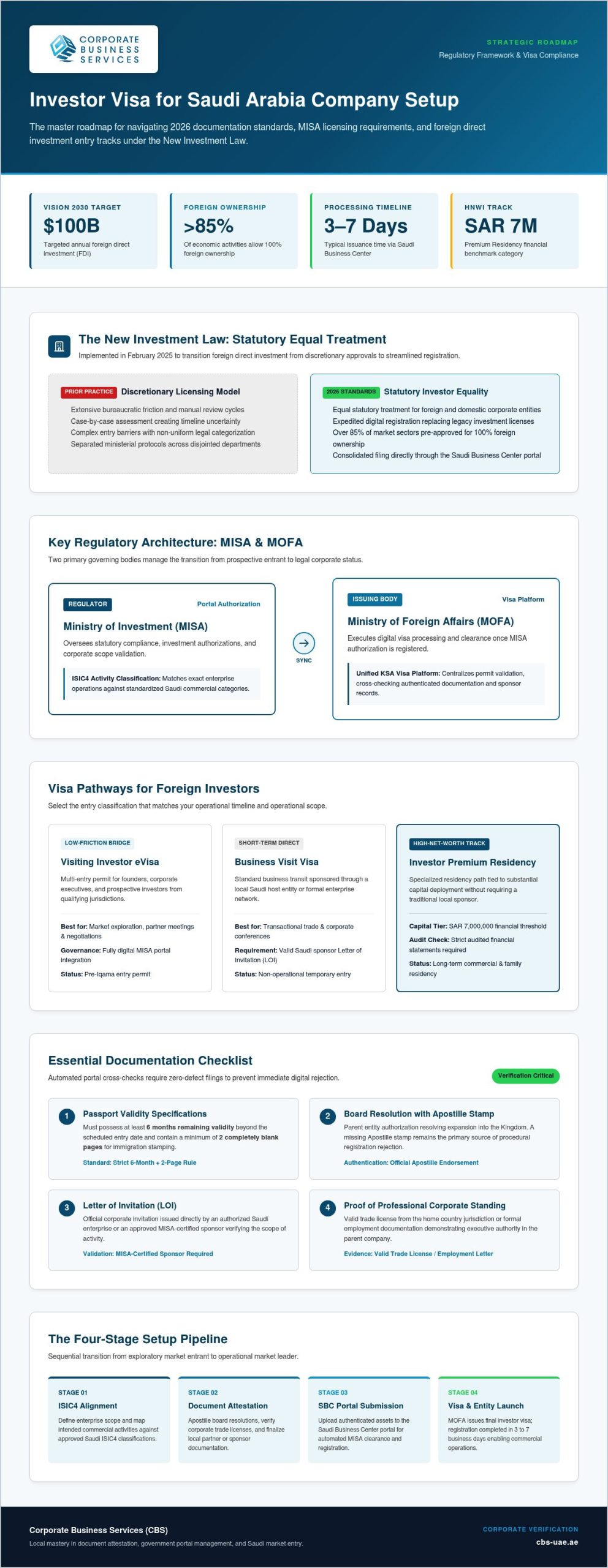
The year 2026 marks a transformative era for global entrepreneurs entering the Kingdom. Following the implementation of the New Investment Law in February 2025, the bureaucratic friction that once defined market entry has largely vanished. This legislative shift grants foreign entities statutory equal treatment, moving away from a discretionary licensing model toward an expedited registration process. For many, the first step is securing an investor visa for saudi arabia company setup, which acts as the formal bridge between initial market research and full-scale operational residency.
Understanding the nuances of Saudi Arabia’s visa policy is essential because 2026 represents a peak in opportunity. Currently, 100% foreign ownership is permitted across more than 85% of economic activities. This openness is a direct result of Saudi Vision 2030, which aims to attract $100 billion in annual foreign direct investment. By distinguishing between a standard commercial visit and a specific investment permit, you ensure your entry aligns with your long-term corporate governance goals. It’s not just about entry; it’s about establishing a legal presence that respects the Kingdom’s ambitious growth targets.
The Evolution of the Visiting Investor Visa
The application process has transitioned into a sophisticated, digital-first experience managed through the MISA portal. This system caters to “International Investors” which, under 2026 regulations, includes prospective founders and corporate executives from qualifying jurisdictions. The Visiting Investor Visa is a multi-entry permit designed specifically for business exploration, partner meetings, and contract negotiations. It serves as a low-friction tool for those who aren’t yet ready for a full Iqama but need consistent access to the Kingdom’s growing ecosystem. This digital integration allows for a rapid transition from explorer to established entity.
Key Regulatory Bodies: MISA and MOFA
A successful entry depends on the synergy between two primary entities. The Ministry of Investment (MISA) serves as your primary regulator, overseeing investment licenses and ensuring your business activities align with the ISIC4 classification. Once MISA provides the necessary digital authorization, the Ministry of Foreign Affairs (MOFA) manages the actual visa issuance through the unified KSA Visa platform. This coordination ensures that your investor visa for saudi arabia company setup is processed with the efficiency required for modern business timelines. Typically, once authenticated documents are uploaded via the Saudi Business Center, the registration can be issued in as little as 3 to 7 business days, reflecting the Kingdom’s commitment to a frictionless investor experience.
Essential Documentation Checklist for International Investors
Securing an investor visa for saudi arabia company setup requires more than just a valid passport; it demands a meticulous assembly of professional and corporate credentials. In 2026, the digital integration between MISA and the Saudi Business Center means that even minor clerical errors can trigger an automated rejection. Your passport must remain valid for at least six months beyond your intended date of entry and contain at least two blank pages for immigration stamps. Additionally, you’ll need to provide a Letter of Invitation (LOI) issued by a Saudi entity or a MISA-certified sponsor, which serves as the formal justification for your business activities in the Kingdom.
Following the U.S. International Trade Administration business travel guidelines for Saudi Arabia ensures your application aligns with standard international protocols. For those targeting high-net-worth individual (HNWI) categories, such as the SAR 7,000,000 Premium Residency track, financial evidence must be corroborated by audited statements. Most applicants will also need to provide proof of their professional status, typically through a trade license from their home country or an official employment letter from their parent company. Our team at CBS provides the local mastery in document attestation needed to bridge the gap between your home country and the Kingdom.
Corporate Document Requirements
The foundation of your application rests on your parent company’s legal standing. You must provide certified copies of your home country trade license or certificate of incorporation. The Memorandum of Association (MOA) is particularly relevant, as it defines the scope of your business activities and must align with the ISIC4 classifications used in the Kingdom. Since Saudi Arabia is now a party to the Hague Apostille Convention, documents from the UK or UAE no longer require the multi-tier consular legalization process. Instead, they only need a standard Apostille stamp and a certified Arabic translation to be accepted by MISA.
Personal and Professional Credentials
While corporate documents form the base, your individual credentials validate your role within the new entity. You’ll need to upload recent digital photographs that meet specific MOFA dimensions and technical requirements. A comprehensive professional CV is often required to highlight your industry experience, especially for regulated sectors. In certain cases, educational certificates must be provided and attested, particularly if you’re applying for professional licenses that require specific technical qualifications. This personal layer of documentation is crucial for those utilizing the investor visa for saudi arabia company setup to manage daily operations as a General Manager or Director.
Navigating MISA Licensing Requirements for Company Setup
The MISA license is the essential engine behind your expansion. While earlier sections focused on entry permits, securing an investor visa for saudi arabia company setup is contingent on obtaining a valid investment license. Under the New Investment Law of 2025, the Ministry of Investment of Saudi Arabia (MISA) has replaced discretionary approvals with a streamlined registration model. This shift ensures that foreign investors receive national treatment, allowing for 100% foreign ownership in over 85% of economic activities. Efficiency is the new standard. By utilizing the Invest Saudi portal, you can bypass the fragmented manual submissions of the past and interact directly with the Kingdom’s regulatory infrastructure.
Selecting the right legal structure is your next strategic decision. Most international firms opt for a Limited Liability Company (LLC) because it offers a robust framework for growth, though branches or Joint Stock Companies are viable for specific corporate goals. Your chosen activity must align with the ISIC4 classification to ensure compliance. This alignment is critical; it dictates your licensing fees and the specific operational permissions your business will hold. It’s a process that rewards precision and local insight.
The MISA License Application Process
- Step 1: Reserve your trade name: This is handled through the Ministry of Commerce via the Saudi Business Center (SBC) portal to ensure your brand identity is unique and compliant.
- Step 2: Upload attested corporate documents: You’ll need to submit your parent company’s articles and resolutions. Thanks to the Hague Apostille Convention, these only require an Apostille stamp and certified Arabic translation.
- Step 3: Pay the MISA license fees: The standard issuance fee is SAR 2,000. Once paid, MISA issues a digital investment license, which is your gateway to formal incorporation.
For a deeper dive into these technicalities, refer to our guide on Securing a MISA License in Saudi Arabia: The 2026 Strategic Guide. This resource outlines the specific nuances of the Invest Saudi portal that can accelerate your timeline.
Post-License Visa Procedures
Obtaining the license is the halfway mark. To fully activate your presence, you must secure a Commercial Registration (CR) from the Ministry of Commerce. For an LLC, the incorporation fee is SAR 1,200 plus publication costs. Once the CR is active, this license allows you to sponsor yourself for an investor visa for saudi arabia company setup, transitioning from a visitor to a resident manager with a formal Iqama. This final stage involves registering with the Chamber of Commerce, the General Organization for Social Insurance (GOSI), and the Qiwa platform. These steps move you from the setup phase into active, compliant operations.
Comparing Visa Categories: Business Visit vs. Investor Residency
Choosing the right entry path is a strategic decision that affects your operational flexibility and tax liability. The investor visa for saudi arabia company setup is not a single document but a choice between three distinct legal mechanisms. For many, the journey begins with the Visiting Investor Visa. This digital eVisa is designed for market exploration and contract negotiations. It’s valid for stays up to 90 days and costs approximately US$135 to US$145, including mandatory health insurance. This permit is ideal for the discovery phase, allowing you to meet partners without the immediate commitment of corporate sponsorship. However, it strictly prohibits local employment or receiving compensation within the Kingdom.
Once your entity is registered, the Investor Residency (Iqama) becomes the standard for daily management. This residency permit is issued after your company secures its MISA license and Commercial Registration (CR). Unlike the visit visa, an Iqama allows you to open personal bank accounts, sponsor family members, and hire domestic staff. It effectively transitions you from a visitor to a resident executive. For a detailed look at how these statuses interact with local regulations, consult our Saudi Arabia Foreign Ownership Laws: The 2026 Investor’s Reference.
Short-term vs. Long-term Entry
The primary difference lies in your rights within the local ecosystem. A visit visa is a 90-day window for negotiation, while the Iqama provides renewable annual residency that anchors your professional life in the Kingdom. Tax implications also shift with your status. Residents are typically subject to Zakat or income tax regulations managed by ZATCA, whereas temporary visitors usually remain under their home country’s tax jurisdiction. If you’re unsure which path aligns with your capital structure, our team provides expert guidance on visa selection to ensure long-term compliance.
The Premium Residency Advantage
For high-capital investors, the Premium Residency “Investor” track offers a “Golden Visa” equivalent that bypasses the need for a corporate sponsor. In 2026, qualifying for this track requires a minimum capital investment of SAR 7,000,000 (approximately US$1.87 million) into economic activities within the first two years. You must also create at least 10 direct local jobs during this period. The benefits are significant, including the right to own real estate and the ability to choose between Limited Duration residency (SAR 100,000/year) or Permanent residency (SAR 800,000 one-time fee). This track is increasingly popular for venture-backed founders who want to secure their interests independently of a specific employment contract.
Strategic Steps to Secure Your Saudi Business Visa with CBS
Securing an investor visa for saudi arabia company setup is a high-stakes endeavor where administrative precision determines your speed to market. At Corporate Business Services (CBS), we act as your authoritative navigator, bridging the gap between your home country operations and the Kingdom’s regulatory requirements. Our team understands the subtle friction points within the MOFA and MISA interface. We don’t just provide advice; we manage the entire government documentation lifecycle. This includes everything from initial MISA portal registration to the final activation of your corporate government files. By entrusting us with your PRO services, you shift the burden of compliance to experts with deep-rooted local insight.
The importance of local mastery cannot be overstated when dealing with document attestation. While the Hague Apostille Convention has simplified the process, ensuring that your board resolutions and financial statements meet the specific standards of Saudi ministries remains a complex task. We ensure your documents are not only attested but correctly translated and formatted for the Saudi Business Center. This proactive approach prevents the common delays that often plague solo applications, positioning your business for long-term growth and immediate operational compliance. We focus on the possibilities of your growth while we handle the technicalities of your transition.
The CBS “One-Stop” Facilitation Model
Our service model is designed for a seamless transition. We manage the entire journey, beginning with document collection in the UK or UAE and concluding with the issuance of your Saudi residency permits. We handle the heavy lifting of liaising with government departments to ensure your approvals are processed rapidly. For a comprehensive look at the broader landscape, explore our Business Setup in Saudi Arabia: The Complete 2026 Entrepreneur’s Guide. This holistic approach ensures that your bank account opening support and tax registration happen in parallel with your visa processing.
Your Market Entry Timeline
Time is your most valuable asset during an expansion. In 2026, the digital integration between MISA and the Saudi Business Center allows for Commercial Registration (CR) issuance within 3 to 7 business days once authenticated documents are uploaded. However, achieving full operational readiness, including bank accounts and your General Manager’s Iqama, typically takes between 3 to 5 weeks. The first 90 days are critical for establishing your National Address via SPL and enrolling with GOSI. We invite you to consult with CBS for a tailored Saudi expansion roadmap that aligns with your specific corporate milestones.
Accelerate Your Entry into the Saudi Market
The 2026 regulatory landscape offers unprecedented opportunities for those prepared to navigate its digital requirements with precision. By understanding the distinction between exploration permits and long-term residency, you can ensure your investor visa for saudi arabia company setup aligns perfectly with your strategic goals. Success depends on the meticulous assembly of attested documents and a clear understanding of the registration-based model now standard in the Kingdom.
As an Emirati-owned consultancy with a proven track record in MISA licensing, Corporate Business Services (CBS) provides the local mastery required to transform complex administrative tasks into a frictionless transition. We offer comprehensive PRO and compliance support to protect your interests while you focus on scaling your operations. Don’t let regulatory changes or documentation hurdles delay your expansion. Secure your Saudi Business Visa and Market Entry Strategy with CBS today. Your journey toward a successful Saudi presence is just beginning, and we’re dedicated to ensuring it’s a seamless one.
Frequently Asked Questions
What is the difference between a Saudi Business Visit Visa and an Investor Visa?
The Business Visit Visa, often called the Visiting Investor eVisa, is a short-term permit designed for market exploration and contract negotiations. It’s typically valid for 90 days and prohibits local employment. In contrast, the Investor Visa is a residency permit (Iqama) issued after company incorporation. This residency allows for long-term operations, hiring staff, and opening personal bank accounts. One is an explorer tool; the other is for active management.
Do I need a local Saudi sponsor to get a business visa in 2026?
No, a local Saudi sponsor is generally not required for most sectors in 2026. Under current investment laws, foreign investors can achieve 100% ownership in over 85% of economic activities. The Kingdom has transitioned from a sponsorship-based model to a registration-based model with MISA. This allows international founders to establish self-sponsored entities, effectively acting as their own corporate sponsor for residency purposes while maintaining full control.
How long does it take to process a Saudi business visa for UK residents?
For UK residents, the Visiting Investor eVisa is typically processed within 24 to 48 hours through the unified KSA Visa platform. However, the full residency permit process requires more time. Once you have your MISA license and Commercial Registration, the Iqama issuance usually takes between 3 to 5 weeks. This timeline includes necessary document attestations and the activation of corporate files on government portals like Qiwa and Muqeem.
Can I open a corporate bank account with a Visiting Investor Visa?
No, you cannot open a full corporate bank account using only a Visiting Investor Visa. Banks in Saudi Arabia require a valid Commercial Registration and a MISA license to initiate corporate account opening. While the visit visa allows you to negotiate with banks and explore financial products, the account itself can only be activated once the legal entity is fully registered and the General Manager’s residency is in process.
What are the costs associated with a MISA investor license in 2026?
In 2026, the standard MISA license issuance fee is SAR 2,000. Additional costs apply for the Commercial Registration, which is SAR 1,200 for a Limited Liability Company, plus publication fees. While MISA historically charged an annual SAR 60,000 subscription fee, various waivers or reduced rates may apply to specific entrepreneur categories. We recommend verifying the latest fee structure during your investor visa for saudi arabia company setup to ensure accurate budgeting.
Is a medical exam required for the Saudi investor residency permit?
Yes, a medical examination is mandatory for anyone applying for a Saudi residency permit or Iqama. This exam must be conducted at an approved medical center and includes screenings for infectious diseases. The results are uploaded digitally to the Efada system, which links directly to the Ministry of Interior’s platform. This requirement does not apply to short-term business visit visas, only to those seeking long-term residency status in the Kingdom.
Can I bring my family to Saudi Arabia on a business visit visa?
You cannot sponsor family members for residency using a business visit visa. This permit is strictly for professional activities. If your family wishes to accompany you, they must apply for separate tourist eVisas or family visit visas. Permanent family sponsorship is only available to those who hold a full investor visa for saudi arabia company setup or a Premium Residency permit, which grants the right to apply for dependent visas.
What happens if my Saudi business visa application is rejected?
If your application is rejected, the Ministry of Investment or MOFA usually provides a digital notification citing the specific reason. Common causes include document attestation errors or activity mismatches with ISIC4 codes. You can typically reapply after addressing the deficiency. Working with an authoritative navigator like CBS ensures that your documentation is meticulously reviewed before submission, significantly reducing the risk of rejection and ensuring a frictionless entry into the market.