In 2026, the traditional requirement for a local partner in Saudi Arabia has shifted from a mandatory hurdle to a strategic choice for most sectors. You’ve likely felt the pressure of keeping up with Vision 2030’s rapid pace or feared that hidden local partner requirements might compromise your corporate autonomy. It’s natural to feel overwhelmed by the complexity of MISA licensing and the evolving regulatory environment. However, the current saudi arabia foreign ownership laws are designed to facilitate growth, offering a more transparent path for international investors than ever before.
This guide serves as your professional reference to master the 2026 investment landscape and secure 100% foreign ownership for your enterprise. We’ll identify the best legal structures for your specific industry and provide a clear roadmap for navigating Saudization and Regional Headquarters (RHQ) rules. You’ll gain a comprehensive understanding of eligibility requirements and the procedural steps needed for a seamless entry. Our goal is to replace your regulatory uncertainty with a structured, efficient plan for regional expansion that prioritizes your control and long term success.
Key Takeaways
- Identify the specific sectors where 100% foreign ownership is now the standard under the updated 2026 regulatory framework.
- Navigate the saudi arabia foreign ownership laws to understand the “Negative List” of activities that still require a local partner.
- Determine whether a Limited Liability Company or a Foreign Branch Office offers the most strategic advantage for your corporate structure.
- Master the nuances of the Nitaqat system and the Regional Headquarters (RHQ) mandate to maintain full compliance with government contracting rules.
- Discover a clear, step-by-step roadmap for securing your MISA license and completing Commercial Registration with professional efficiency.
The Evolution of Saudi Arabia Foreign Ownership Laws
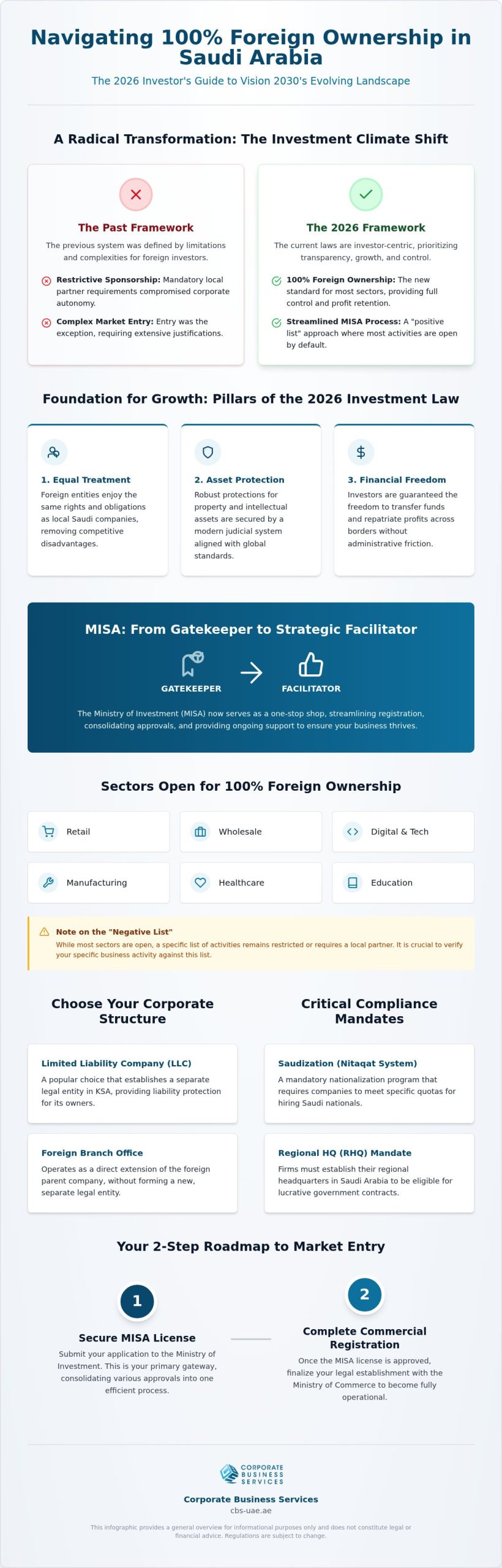
The landscape of saudi arabia foreign ownership laws has undergone a radical transformation, moving away from the era of restrictive sponsorship to a modern, investor-centric framework. By 2026, the Kingdom has fully implemented its updated Investment Law, which aligns local regulations with global standards to attract diverse international capital. This shift is a direct result of Vision 2030 milestones, which have effectively dismantled the barriers that once made market entry a daunting prospect for international firms. You’ll find that the environment is no longer defined by what you can’t do, but by the strategic possibilities available to your business.
Previously, investors faced a system where entry was the exception. Now, the “positive list” approach means that the vast majority of economic activities are open to 100% foreign ownership unless they appear on a narrow, specific list of restricted sectors. This change reflects a broader commitment to transparency and ease of doing business, positioning the Kingdom as a competitive hub in the Middle East. It’s a structured evolution that prioritizes the stability and growth of foreign entities within the local economy.
The 2026 Investment Law: Key Principles
The current legal framework is built upon three pillars that provide the certainty needed for long term capital commitments. First, the principle of equal treatment ensures that foreign entities enjoy the same rights and obligations as local Saudi companies. This removes the competitive disadvantage often felt by international players in emerging markets. You’re treated as a local stakeholder from day one.
Second, the law provides robust protections for property and intellectual assets. Investors can be confident that their innovations and physical holdings are secured by a modern judicial system that respects international standards. Finally, the freedom to transfer funds is guaranteed. You can repatriate profits or move capital across borders without the administrative friction that characterized the previous decade. These principles create a frictionless experience for those looking to scale their operations quickly.
The Role of MISA in Modern Ownership
The Ministry of Investment (MISA) has evolved from a traditional regulator into a proactive facilitator. Instead of acting as a gatekeeper that demands exhaustive justifications for entry, MISA now focuses on streamlining the registration process for new enterprises. This transition has significantly reduced the time required to move from an initial concept to an operational business. Understanding the nuances of saudi arabia foreign ownership laws is much simpler when you view MISA as a strategic ally rather than a bureaucratic hurdle.
The MISA license serves as the primary gateway for 2026 investors, consolidating various regulatory approvals into a single, efficient process. Beyond just issuing licenses, MISA provides ongoing support to ensure that businesses remain compliant with evolving standards. By acting as a central point of contact, they simplify the journey for outsiders, making the transition into the Saudi market feel like a partnership rather than a struggle. This one-stop approach ensures that your focus remains on your core business objectives while the regulatory details are handled with professional precision.
Achieving 100% Foreign Ownership in 2026
Securing total control over your venture is the primary objective for most international firms entering the Kingdom. Under the current saudi arabia foreign ownership laws, the path to 100% equity is clearer than it has ever been. This autonomy effectively eliminates the historical need for a local partner, allowing you to retain full profit shares and maintain absolute authority over your strategic direction. It’s no longer a matter of if you can own your business entirely, but how you structure it to meet sector-specific requirements.
Eligible Industries for Full Ownership
The 2026 framework broadly categorizes retail, wholesale, and various service sectors as eligible for full foreign equity. Digital and technological services have seen the most significant expansion; the government actively incentivizes international tech firms to establish a permanent presence. Similarly, the manufacturing and industrial sectors offer attractive incentives for those bringing specialized expertise and infrastructure to the local market. Full control is your greatest asset in these competitive fields.
Healthcare and education have also undergone extensive liberalization. International providers can now operate schools and medical facilities with 100% ownership, provided they meet the quality standards set by the respective ministries. If you’re looking to launch in these high-growth sectors, professional business setup in Saudi Arabia ensures your licensing aligns with these modern standards from the outset. This structured approach protects your intellectual property and simplifies your long term expansion strategies.
Understanding the 2026 Negative List
While the market is more open than ever, certain strategic activities remain on the “Negative List.” These specific areas require a Saudi partner or are reserved exclusively for nationals. Upstream oil and gas activities, specifically those involving exploration and production, remain restricted to protect national resources. Real estate brokerage and recruitment services also require local participation, as these sectors are deeply tied to domestic labor and land regulations.
Security and military-adjacent services are another area where full foreign ownership is restricted. These limitations are strictly defined to ensure national security interests are maintained. Outside of these specific exclusions, the regulatory environment is remarkably permissive. Understanding these boundaries early prevents costly delays during the MISA application phase. The 2026 list is narrower than in previous years, reflecting a continued commitment to market openness.
Capital requirements for 100% foreign-owned entities have been standardized across many sectors, though some, like wholesale and retail trading, may still require specific investment thresholds. The strategic advantage of full control far outweighs these initial commitments. By removing the complexity of a local partnership, you simplify your corporate governance and ensure that every decision aligns with your global parent company’s vision.
Comparative Analysis: Saudi Corporate Structures for Foreigners
Choosing the right legal entity is as critical as understanding the saudi arabia foreign ownership laws themselves. While the Limited Liability Company (LLC) remains the most popular choice for 100% ownership, it isn’t the only path. Your decision depends on your long term commercial goals, risk appetite, and the specific needs of your UK parent company. For instance, a Technical Scientific Office is an excellent entry point for those focused on market research or technical support rather than direct sales. It allows you to establish a presence without the capital requirements of a full commercial entity.
The LLC vs. Branch Office Decision
The Limited Liability Company (LLC) is often the preferred route because it creates a separate legal entity. This structure limits the liability of the UK parent company to its capital contribution within the Kingdom. It’s a robust shield for international investors. Operationally, an LLC offers maximum flexibility for hiring and contracting, though it requires a more structured setup process including Articles of Association.
In contrast, a Foreign Branch Office is an extension of your existing UK company. It doesn’t have a separate legal personality, meaning the parent company remains liable for the branch’s actions. While the setup can be faster in some cases, the tax implications and licensing requirements differ. Branches are typically used by companies with significant international footprints that want to maintain a direct, unified brand presence. Both structures require a MISA license, but the choice impacts your administrative burden and financial reporting requirements significantly.
Joint Ventures in the Modern Era
Even with the freedom offered by 100% ownership, many investors still opt for a Joint Venture (JV). A local partner can provide invaluable strategic value, such as established networks, deep market insights, and existing relationships with government entities. It’s a way to accelerate growth in complex sectors where cultural nuances play a major role in business development. In 2026, these partnerships are governed by sophisticated shareholder agreements that protect all parties involved.
If your strategy involves a direct extension of your current operations, you might want to establish a branch in Saudi Arabia to maintain total control. However, if you’re entering a highly competitive service market, a JV might be the faster route to securing market share. Managing these agreements under current saudi arabia foreign ownership laws requires a meticulous approach to corporate governance to ensure compliance and clarity for both the foreign investor and the local partner. This ensures that your expansion is not just legally sound, but strategically optimized for the local landscape.
Critical Compliance: Saudization and Regional Headquarters (RHQ)
Maintaining your status under saudi arabia foreign ownership laws requires more than just an initial license. You must adhere to ongoing operational standards, primarily revolving around local employment and regional governance. Failure to meet these benchmarks doesn’t just result in fines; it can jeopardize your ability to renew your MISA license or expand your operations. Compliance is the foundation upon which your corporate longevity is built.
Foreign-owned firms are generally subject to a 20% corporate tax on net profit. This differs from local entities or GCC-owned companies that primarily pay Zakat. Understanding these fiscal obligations early helps in accurate financial forecasting and ensures your business remains in good standing with the Zakat, Tax and Customs Authority (ZATCA). While the tax rate is competitive, the reporting requirements are meticulous and require professional oversight to avoid penalties.
Navigating the RHQ Program
By 2026, any international firm seeking to sign contracts with Saudi government agencies or state-owned entities must establish a Regional Headquarters (RHQ) in the Kingdom. This mandate is a cornerstone of the current investment strategy. It’s designed to ensure that companies benefiting from massive state projects also contribute to the local economic ecosystem. The RHQ license offers significant advantages, including a 30-year corporate tax holiday and exemptions from certain Saudization requirements for the first few years. It’s an elite tier of setup designed for those committed to the Kingdom’s long term vision. For a detailed breakdown of the application process, consult our Saudi Arabia business setup guide.
Employment and Saudization Strategy
The Nitaqat system remains the primary tool for managing workforce quotas. It categorizes companies into color zones based on their percentage of Saudi employees. Staying in the “Green” or “Platinum” zones is essential for processing employee visas and maintaining operational fluidity. While the requirements vary by industry, the pressure to localize talent is consistent across all license types. You’ll need a robust recruitment and training plan to meet these thresholds without compromising your service quality.
High-level foreign executives can leverage the “Premium Residency” option to bypass some traditional visa constraints, providing more stability for your leadership team. However, your overall Saudization strategy must be proactive. Don’t wait for a downgrade in your Nitaqat status to address hiring gaps. If you need help structuring your workforce to comply with saudi arabia foreign ownership laws, our team provides expert business setup in Saudi Arabia to manage your government documentation and labor relations efficiently. This proactive approach ensures your license remains secure while you focus on scaling your operations.
Implementing Your Expansion Strategy with CBS
Moving from a strategic plan to an operational reality requires a methodical approach to the Kingdom’s regulatory milestones. By 2026, the process of aligning with saudi arabia foreign ownership laws has been significantly digitized, yet it still demands meticulous attention to detail. We act as your authoritative navigator, ensuring that each phase of the setup is executed with professional efficiency and clarity.
The journey to operational readiness typically follows a structured four step progression:
- Step 1: Activity Selection and MISA License Application. You’ll start by selecting the specific ISIC activities that qualify for your desired ownership structure. We then facilitate the submission of your application to the Ministry of Investment.
- Step 2: Commercial Registration (CR) and Articles of Association. Once your MISA license is issued, we help draft the Articles of Association and secure your Commercial Registration from the Ministry of Commerce.
- Step 3: Post-Licensing Registrations. Your business must be registered with the Chamber of Commerce, the Zakat, Tax and Customs Authority (ZATCA), and the General Organization for Social Insurance (GOSI).
- Step 4: Visa Processing and Bank Account Opening. The final stage involves securing the necessary work visas for your team and navigating the complexities of opening a local corporate bank account.
Professional Guidance for a Frictionless Setup
Navigating government documentation and PRO services requires deep local insight. We handle the intricate details of the setup process, from notarizing documents to communicating with local authorities. This allows you to focus on your core commercial objectives while we manage the administrative heavy lifting. Beyond the initial setup, we provide professional accounting and tax advisory to ensure your entity remains in full compliance with regional fiscal standards. For those ready to begin the first phase, securing a MISA license is your most critical priority.
Your Long-Term Partner in the Kingdom
Expansion doesn’t end with a license. We offer ongoing corporate secretarial support to manage license renewals, document updates, and regulatory filings. As your business grows, we provide strategic consulting to help you adapt to any future changes in the investment landscape. Our commitment is to provide a seamless transition and a stable foundation for your long term success. You’re not just setting up a business; you’re building a legacy. Start your Saudi expansion with Corporate Business Services (CBS) today to experience a truly professional and supportive partnership.
Securing Your Future in the Saudi Market
The transition toward 100% ownership has transformed the Kingdom into a premier destination for global capital. By aligning your corporate structure with the latest 2026 regulations, you can maintain full autonomy while scaling your operations effectively. Success in this landscape requires a deep understanding of saudi arabia foreign ownership laws and a proactive approach to the compliance requirements we’ve discussed, such as Saudization and the RHQ mandate.
As an Emirati-owned consultancy with deep regional insight, Corporate Business Services (CBS) acts as your authoritative navigator throughout this journey. We provide end-to-end PRO and government documentation support, coupled with comprehensive accounting and tax advisory services to ensure your transition is entirely frictionless. Our team is dedicated to simplifying the complex so you can focus on your business growth. Consult with our Saudi expansion experts at Corporate Business Services (CBS) to begin your journey with confidence. Your expansion into the Kingdom is a major milestone, and we’re here to ensure every step is steady and successful.
Frequently Asked Questions
Can a UK citizen own 100% of a company in Saudi Arabia?
Yes, a UK citizen can own 100% of a business in the Kingdom under the 2026 saudi arabia foreign ownership laws. This applies to most commercial activities including retail, wholesale, and professional services. By obtaining a MISA license, you can maintain full equity without the historical requirement of a local Saudi partner. This structure ensures you retain complete control over your strategic decisions and profit repatriation.
What is the minimum capital required for a 100% foreign-owned LLC?
Minimum capital requirements in 2026 are determined by your specific business activity rather than a flat rate. While many service-based LLCs don’t have a high statutory minimum, trading licenses often require a substantial investment to qualify for 100% ownership. It’s essential to verify the current thresholds for your industry before applying. We recommend a capital structure that reflects your operational needs and demonstrates financial commitment to the local authorities.
Does the Regional Headquarters (RHQ) law apply to all foreign companies?
The Regional Headquarters mandate doesn’t apply to every foreign company. It’s specifically required for international firms that want to bid on government contracts or work with state-owned entities. If your business model focuses entirely on the private sector, establishing an RHQ is optional. However, many companies choose this route anyway to take advantage of the 30-year tax holiday and simplified visa quotas offered by the program.
What are the restricted sectors on the Saudi “Negative List” in 2026?
The 2026 “Negative List” remains focused on sectors involving national security and strategic resources. Restricted activities include upstream oil and gas exploration, recruitment services, and real estate brokerage. These areas typically require a Saudi partner or are reserved for nationals. Most other sectors, like technology, manufacturing, and healthcare, are fully open. Reviewing this list early in your planning phase prevents delays in your MISA license application.
How long does it take to get a MISA license for foreign ownership?
Obtaining a MISA license has become significantly faster through the 2026 digital registration portal. Once your notarized documents are verified, the license is typically issued within 3 to 5 business days. The entire setup process, including your Commercial Registration and tax setup, usually takes between three and five weeks. Working with a professional consultant ensures your documentation is correct, preventing any unnecessary administrative friction or delays during the process.
Is a local Saudi manager required for a foreign-owned business?
A local Saudi manager isn’t a mandatory requirement for foreign-owned firms. You’re free to appoint a manager of any nationality to lead your operations. This individual must reside in the Kingdom and hold a valid residency permit to represent the company in government transactions. While a Saudi manager isn’t legally required, many firms choose to hire local executives to leverage their specific market insight and facilitate smoother government relations.
Can foreign companies own real estate in Saudi Arabia for business use?
Foreign companies are permitted to own real estate for their own commercial use or for housing their employees. This allows you to build a permanent base and invest in long-term infrastructure. However, purchasing property for the sole purpose of real estate investment or brokerage is still restricted under current saudi arabia foreign ownership laws. You must obtain specific approvals to ensure the property is used strictly for your business operations.
How does Saudization (Nitaqat) affect foreign-owned startups?
Saudization, or the Nitaqat system, applies to all businesses, including foreign-owned startups. While new companies often receive a grace period to meet their initial quotas, you’re expected to hire Saudi nationals as you scale. Maintaining a high Nitaqat color rating is essential for visa renewals and government services. Incorporating local talent into your early hiring strategy isn’t just a compliance requirement; it’s a strategic move to integrate your business into the local economy.