What if you could project your global brand’s prestige directly into the heart of the Middle East without the administrative friction of a separate legal entity? For many international firms, the decision to establish a branch in saudi arabia is the most strategic path to capturing the momentum of Vision 2030 while maintaining 100% foreign ownership and direct parent company control. We understand that the 2026 regulatory environment, with its evolved MISA licensing protocols and stringent profession-specific Saudization quotas, can appear daunting to even the most seasoned investors.
It’s natural to feel concerned about navigating the distinction between branch tax implications and traditional LLC structures. This comprehensive reference guide eliminates that confusion by detailing the exact legal requirements and strategic advantages of the branch model. You’ll gain a clear, step-by-step roadmap for your entry into the Saudi economy, covering everything from initial government documentation to the latest Qiwa platform mandates. Whether you’re a UK-based firm or a global enterprise, this guide ensures your expansion is orderly, compliant, and positioned for long-term growth.
Key Takeaways
- Learn why 100% foreign ownership and direct parent company control make the branch model a premier choice for global firms entering the Saudi market.
- Master the exact procedural requirements to establish a branch in saudi arabia, including the latest 2026 MISA licensing and Ministry of Commerce protocols.
- Evaluate the critical differences in liability and taxation between branch offices and LLCs to determine the most cost-effective path for your expansion.
- Navigate the complexities of the 2026 Nitaqat system and profession-specific Saudization quotas to ensure your entity remains fully compliant.
- Gain clarity on essential government documentation and PRO services required to streamline your administrative transition and long-term operations.
Strategic Advantage of a Saudi Branch in 2026
The decision to establish a branch in saudi arabia in 2026 represents a sophisticated entry strategy for global enterprises. Unlike a Limited Liability Company (LLC), which creates a separate legal person, a branch functions as a direct extension of your international headquarters. This structure preserves your brand’s integrity and ensures that your corporate culture remains consistent across borders. As the Kingdom accelerates its economic diversification, the branch model has emerged as a preferred vehicle for firms looking to maintain 100% foreign ownership while benefiting from a streamlined regulatory path.
Vision 2030 and Foreign Investment
Saudi Arabia’s economic transformation is anchored by the Ministry of Investment (MISA), which has digitized the application process to ensure a frictionless experience for new entrants. In 2026, we’re seeing high approval rates for branches in specialized sectors like engineering, procurement, and high-tech services. The government’s push for transparency means that licensing requirements are clearer than ever, allowing you to move from application to operation with confidence. By choosing to establish a branch in saudi arabia, you align your business with the Kingdom’s goal of attracting world-class expertise to support massive national infrastructure projects.
Direct Control and Liability
One of the primary reasons to choose a branch structure is the level of direct control it affords the parent company. Because the branch isn’t a separate legal entity, your global leadership maintains full oversight of local operations, financial decisions, and strategic direction. While this means the parent company remains legally responsible for the branch’s obligations, it also eliminates the need for a complex local board of directors or a Saudi partner. This direct link simplifies your internal reporting and ensures that your global standards are applied without compromise.
This direct link is particularly relevant under the 2026 Regional Headquarters (RHQ) mandate. For firms looking to secure government contracts, the RHQ program offers a 30-year corporate tax exemption. Many organizations find that operating a network of branch offices under an RHQ umbrella provides the perfect balance of local presence and centralized governance. It’s a cohesive way to manage your Saudi portfolio while meeting the requirement of having at least 30 employees, including executive leadership, within your regional hub. This setup ensures your brand remains agile and protected as you grow within the Kingdom’s dynamic market.
Legal Framework and MISA Licensing Requirements
The regulatory architecture for foreign investment is governed by the Ministry of Investment of Saudi Arabia (MISA). To establish a branch in saudi arabia, your first step is securing a foreign investment license. This process has been significantly refined for 2026, moving toward a digital-first approach through the MISA investor portal. This centralized system ensures that your application is tracked and processed with the transparency required for international corporate governance.
The MISA Investment License
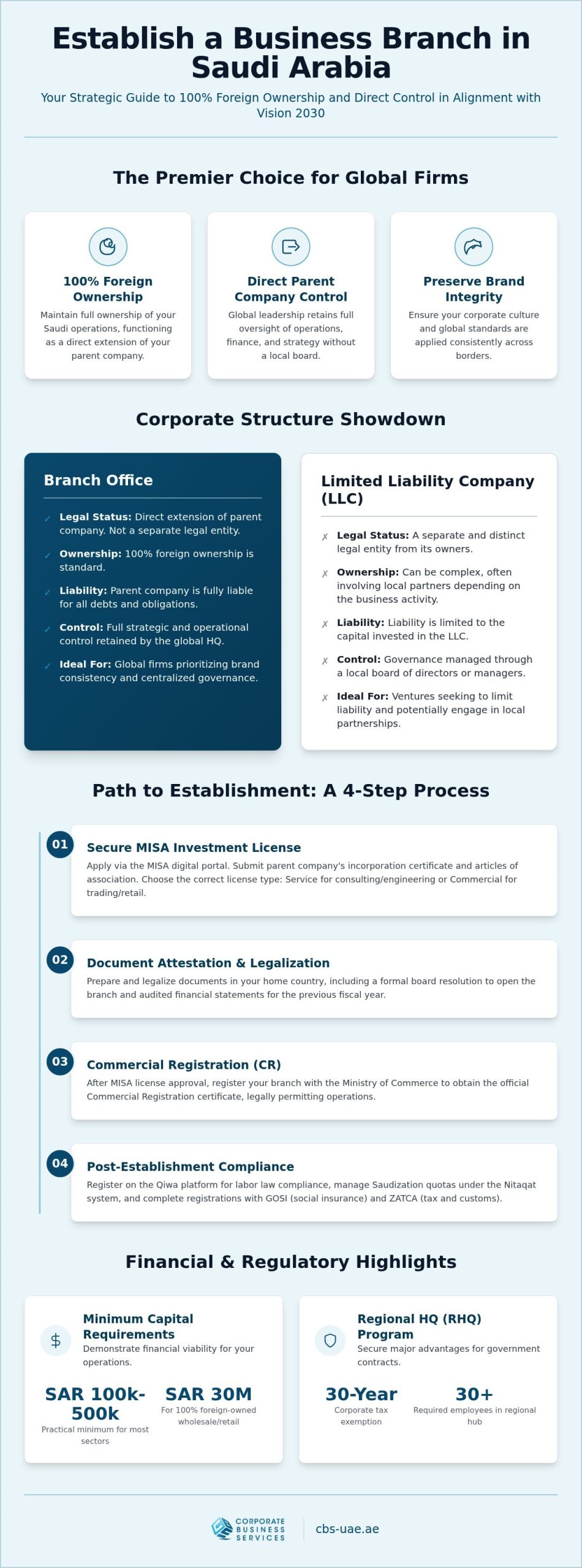
The MISA investment license serves as the foundational permit required for all foreign entities seeking a presence in the Kingdom. When applying through the digital portal, you must provide your parent company’s certificate of incorporation and articles of association. It’s vital to select the license type that accurately reflects your intended operations. A Service License is generally reserved for consulting, engineering, or technical firms, while a Commercial License is mandatory if your branch will engage in trading or retail activities. Approval typically hinges on your business’s ability to align with national investment priorities, such as local talent development or technology integration.
While the 2022 Companies Law removed statutory minimum capital for many entities, MISA and local banks often expect a practical minimum of SAR 100,000 to SAR 500,000 to demonstrate financial viability. However, specific sectors have higher thresholds. For instance, a 100% foreign-owned wholesale or retail branch requires a minimum cash capital of SAR 30 million. Understanding these nuances early ensures your financial planning remains accurate as you establish a branch in saudi arabia.
Document Attestation and Legalization
The administrative journey begins in your home country with the preparation of essential corporate records. You’ll need a formal board resolution stating the parent company’s intent to open the branch, alongside audited financial statements from the previous fiscal year. These documents must undergo a rigorous legalization process. For UK and international firms, this involves obtaining an Apostille or attestation by the Saudi Embassy in your home jurisdiction.
Once the documents arrive in the Kingdom, they require final legalization by the Ministry of Foreign Affairs (MOFA). It’s also a legal requirement that all non-Arabic documents are translated by certified translators authorized to work with Saudi government bodies. Managing these government documentation requirements correctly from the start prevents costly delays in your setup timeline. Our team acts as your navigator through this process, ensuring every stamp and translation meets the exacting standards of Saudi authorities.
Comparing Corporate Structures: Branch Office vs. LLC
Choosing between a branch and a Limited Liability Company (LLC) is a pivotal decision when you decide to establish a branch in saudi arabia. While both structures allow for 100% foreign ownership in most sectors in 2026, they differ significantly in legal liability and administrative maintenance. A branch is legally inseparable from its parent company; this means the parent is directly liable for all debts and obligations incurred by the Saudi entity. In contrast, an LLC provides a protective ring-fence, limiting the parent company’s liability to its share capital. This distinction is critical for risk management, especially for firms entering high-capital sectors like construction or manufacturing.
Taxation for both entities involves a 20% corporate income tax on the foreign-owned portion of profits. However, the administrative complexity of filing can vary. Branches are often viewed as a “Permanent Establishment,” which can trigger specific tax reporting requirements in the parent company’s home jurisdiction. While LLCs require a more robust internal governance structure, including a local board of managers, branches benefit from a leaner setup that mirrors the parent company’s existing corporate governance. This often results in lower ongoing administrative overhead for large multinationals.
Decision Matrix for Foreign Investors
A branch office is typically the preferred choice for firms executing short-term projects or those wishing to extend an existing global brand without the overhead of a new corporate identity. It’s an efficient way to establish a branch in saudi arabia when brand consistency and direct control are your top priorities. However, if your operations involve high-risk activities or require significant local market penetration over decades, an LLC might be more appropriate. You should also consider that while general capital requirements are flexible, 100% foreign-owned retail and wholesale entities require a minimum cash capital of SAR 30 million, regardless of whether they are branches or LLCs.
Ownership and Management Flexibility
In 2026, both structures benefit from the Kingdom’s streamlined ownership laws. A branch must appoint a General Manager (GM) who resides in Saudi Arabia to oversee daily operations. This GM holds significant legal powers, including the authority to sign contracts and manage government relations via the Qiwa and Muqeem platforms. For a deeper look at alternative structures, read our Business Setup in Saudi Arabia: The Complete 2026 Entrepreneur’s Guide. This localized management ensures that even though the branch is a part of a global firm, it operates with the agility of a local entity, allowing for a seamless integration into the Saudi economy.
Step-by-Step Procedure to Establish a Branch in Saudi Arabia
The journey to establish a branch in saudi arabia has been transformed by the Kingdom’s digital integration initiatives. In 2026, the process is structured into four distinct phases that move your business from a foreign concept to a functional local entity. This methodical approach ensures that every regulatory requirement is met with precision, allowing you to focus on your market entry strategy rather than administrative bottlenecks. By following this sequence, you can navigate the complexities of the Saudi bureaucracy with the confidence of an insider.
Commercial Registration and Articles of Association
Once you have secured your initial investment permit, you move into the Commercial Registration (CR) phase with the Ministry of Commerce. The CR functions as the “identity card” for your Saudi business; it is the document that local vendors, banks, and government agencies will use to verify your legal existence. A critical component of this phase is reserving a trade name. Your chosen name must comply with specific Saudi regulations, ensuring it is unique and does not mirror existing local brands. For a deeper dive into the preceding steps, consult our guide on Securing a MISA License in Saudi Arabia: The 2026 Strategic Guide.
The third phase involves integrating with the Kingdom’s social and labor systems. You must open a file with the Ministry of Human Resources and Social Development (MHRSD) and the General Organization for Social Insurance (GOSI). These registrations are mandatory for hiring both Saudi nationals and expatriate staff. Finally, you must establish a national address. This requires a physical office lease that meets government standards, providing a verified location for official correspondence and site inspections by regulatory bodies.
Post-Registration Essentials
Completing your registration is only the beginning of your operational compliance. You must register with the Zakat, Tax and Customs Authority (ZATCA) to manage your Corporate Tax and VAT obligations. In 2026, this includes adherence to Phase 2 e-invoicing requirements, which necessitates specialized software integration. Additionally, obtaining a membership with the Chamber of Commerce is essential for authenticating commercial documents and accessing local business networks.
The final hurdle is often the opening of a corporate bank account. This step is vital for the initial capital injection and ongoing financial transactions. Banks in the Kingdom have rigorous “Know Your Customer” (KYC) protocols, making it helpful to have all your legalized documents prepared in advance. If you are ready to begin this transition, our team provides comprehensive business setup in Saudi Arabia to ensure your expansion is seamless and efficient.
Ensuring Long-Term Compliance and PRO Support
Once you establish a branch in saudi arabia, the focus shifts from initial setup to sustainable growth. The Kingdom’s regulatory environment moves quickly, and long-term success depends on your ability to adapt to evolving labor laws and tax mandates. Annual MISA license renewals and strict adherence to International Financial Reporting Standards (IFRS) are non-negotiable for foreign branches. Staying ahead of these requirements ensures your operations remain uninterrupted and your reputation with Saudi authorities stays pristine.
Saudization and Labour Law Compliance
The Nitaqat system is the cornerstone of Saudi labor policy. As of April 26, 2026, the program entered a new phase of “Developed Nitaqat” with heightened profession-specific quotas. For example, establishments with three or more employees in sales and marketing roles must meet a 60% Saudization ratio. Engineering roles require 30%, while procurement is set at 70%. Maintaining a “Green” or “Platinum” status is vital, as these categories grant your branch easier access to work visas and government services.
To stay compliant, you must document all Saudi employee contracts on the Qiwa platform. Since April 15, 2026, only employees registered on Qiwa count toward your company’s Saudization ratio. Additionally, you’ll need to manage payroll through the Mudad portal to comply with the Wage Protection System. This digital-first approach to labor management requires meticulous attention to detail but offers a more transparent way to handle international expertise alongside local talent.
The CBS Advantage: Your Strategic Expansion Partner
Managing these ongoing requirements doesn’t have to be a burden for your global leadership. Corporate Business Services (CBS) acts as your authoritative navigator, providing a frictionless experience for international firms. We offer end-to-end support, from the initial government documentation to complex PRO services that handle all government liaisons on your behalf. Our team simplifies the complexities of the 20% corporate income tax and 15% VAT filings, ensuring your branch remains fully compliant with ZATCA regulations.
We also provide specialized support for bank account opening and ZATCA Phase 2 e-invoicing integration. By partnering with an Emirati-owned consultancy that possesses deep-rooted local insight, you ensure your Saudi expansion is both orderly and ambitious. We’re dedicated to helping you establish a branch in saudi arabia that isn’t just a legal entity, but a thriving extension of your global brand. Let us handle the administrative intricacies so you can focus on the possibilities of growth in the Kingdom.
Secure Your Corporate Future in the Kingdom
Choosing to establish a branch in saudi arabia is a powerful statement of intent in a market defined by rapid diversification and immense scale. Throughout this guide, we’ve explored how the branch model preserves your brand’s integrity while allowing for 100% foreign ownership and direct parent company control. Success in 2026 requires more than just a permit; it demands a deep understanding of the Kingdom’s digital-first regulatory environment, from MISA licensing to the nuances of the latest Nitaqat labor quotas. By aligning your global standards with local requirements, you position your firm at the center of the Middle East’s most dynamic economy.
Expanding your footprint requires an authoritative navigator who understands the complexities of Saudi corporate governance. As Emirati-owned experts, our team provides the end-to-end MISA license support and comprehensive PRO services you need for a frictionless entry. We handle the administrative intricacies so you can focus on the strategic possibilities of Vision 2030. Partner with CBS to establish your Saudi branch today and begin your journey with confidence. Your growth in the Kingdom should be as orderly as it is ambitious, and we’re here to ensure every step is a success.
Frequently Asked Questions
Can a foreign company own 100% of a branch in Saudi Arabia?
Yes, 100% foreign ownership is the standard for most branch offices under current MISA regulations. This allows international parent companies to maintain full control without the need for a local partner or shareholder. It is a significant advantage for global firms that want to establish a branch in saudi arabia while keeping their existing corporate structure and brand identity intact throughout their expansion into the Kingdom.
How long does it take to establish a branch in Saudi Arabia in 2026?
The setup process typically takes between 4 to 8 weeks, provided all parent company documents are ready. The digital integration of the MISA and Ministry of Commerce portals has streamlined the timeline significantly in 2026. However, the document legalization process in your home country often takes the most time. Preparing your board resolutions and audited financial statements early is essential for a frictionless and predictable experience.
What is the minimum capital required to open a Saudi branch office?
While the 2022 Companies Law removed a universal statutory minimum for many entities, MISA often expects a practical minimum of SAR 100,000 to SAR 500,000 to prove financial viability. Specific sectors have higher thresholds. For example, a 100% foreign-owned wholesale or retail branch requires SAR 30 million in cash capital. Industrial licenses often start at SAR 1 million. It is vital to verify the specific threshold for your licensed activity.
Do I need a Saudi partner or sponsor to open a branch?
No, you don’t need a Saudi partner or a local sponsor to establish a branch in saudi arabia. The branch office is a direct extension of the foreign parent company, which holds full legal responsibility for the entity. Unlike older regional models, the current Saudi investment framework allows you to manage your operations and capital independently. You only need to appoint a resident General Manager to handle local administrative tasks.
What is the difference between a branch office and a representative office?
A branch office can engage in commercial activities, sign contracts, and generate revenue within the Kingdom. In contrast, a representative office is strictly limited to market research and promotional activities for the parent company. It cannot trade, issue invoices, or perform profit-generating work. For most firms looking to actively participate in the Saudi economy and secure government contracts, the branch structure is the appropriate choice for operational flexibility.
Are branch offices subject to corporate tax in Saudi Arabia?
Yes, branch offices are subject to a 20% corporate income tax on their net profits. Because the branch is foreign-owned, it doesn’t pay Zakat, which is reserved for Saudi and GCC-owned shares. You’ll also need to register for VAT if your annual taxable supplies exceed SAR 375,000. Compliance with ZATCA e-invoicing Phase 2 requirements is also mandatory for all branches operating in the Kingdom in 2026.
Is it mandatory to have a physical office to register a branch?
Yes, having a physical office with a verified national address is a legal requirement for completing your registration. The Ministry of Commerce and MISA require a formal lease agreement to issue your Commercial Registration. This office serves as your official headquarters for government inspections, postal correspondence, and labor file openings. Virtual offices aren’t generally accepted for foreign branch entities under the current regulatory framework for international investors.
Can a branch office sponsor visas for international employees?
Yes, a registered branch office can sponsor work visas for international employees once it has opened a labor file with the MHRSD. However, your ability to secure these visas depends on your Nitaqat category and Saudization ratio. You must comply with profession-specific quotas, such as the 60% requirement for sales and marketing roles. All employee contracts must also be documented on the Qiwa platform to count toward your compliance status.