What if the prestige of a DIFC address is actually a strategic bottleneck for your 2026 expansion plans? It’s a question many international investors are asking as the UAE’s regulatory landscape undergoes its most significant transformation in a decade. You likely feel the weight of the new 9% corporate tax regime and the pressure to choose between the familiar embrace of English Common Law or the vast market reach of UAE Civil Law. Deciding on difc vs mainland dubai isn’t just about where your office sits; it’s about defining your operational DNA for the next five years.
We understand that the fear of choosing a restrictive jurisdiction can stall even the most ambitious growth strategies. This guide serves as your authoritative navigator, cutting through the complexity to help you secure a clear ROI-based jurisdiction choice. You’ll gain a comprehensive understanding of 2026 tax compliance, the nuances of the DEWS savings scheme, and how to ensure a seamless bank account opening process. We’re moving beyond the basics to explore how Executive Council Resolution No. 11 of 2025 is fundamentally changing the way free zone entities interact with the mainland market.
Key Takeaways
- Understand why the DIFC’s English Common Law framework remains the premier choice for international investors seeking familiar legal protection and complex arbitration.
- Evaluate the operational trade-offs of difc vs mainland dubai, balancing specialized financial district access against unrestricted trading rights across the entire UAE.
- Navigate the 2026 corporate tax landscape by identifying how to maintain “Qualifying Free Zone Person” status to manage the 9% tax threshold effectively.
- Discover how your jurisdiction choice directly influences your long-term residency goals and eligibility for the UAE Golden Visa.
- Gain a clear, ROI-driven decision matrix to align your specific business activity with the most cost-effective and compliant licensing structure for future growth.
Understanding the 2026 Landscape: DIFC vs Mainland Dubai
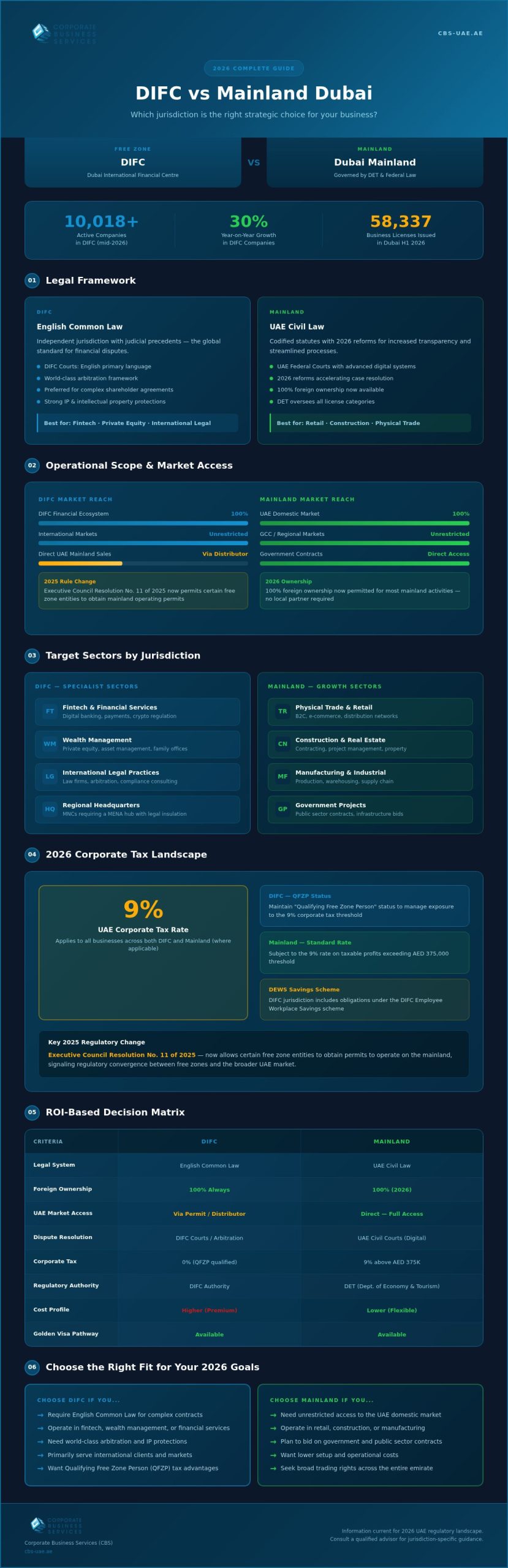
Choosing between a setup in the Dubai International Financial Centre (DIFC) and the Dubai Mainland requires a deep understanding of how the UAE’s commercial map has evolved. By mid-2026, the DIFC has matured into a powerhouse with over 10,018 active companies, representing a 30% year-on-year increase. It functions as a specialized financial free zone with its own independent legal system. Conversely, the Dubai Mainland encompasses the broader territory of the emirate, where the business landscape is governed by federal laws and civil courts.
A pivotal shift for 2026 is the widespread adoption of 100% foreign ownership for most mainland activities. This change has removed the historical requirement for a local partner, making the difc vs mainland dubai decision more about strategic market access than simple ownership control. As an Emirati-owned consultancy, we provide the local mastery needed to bridge these two distinct environments. We act as your authoritative navigator, ensuring your documentation and setup align with the latest 2026 standards while simplifying the complexities of local governance.
The Regulatory Authorities: DIFC vs DET
The DIFC Authority manages the financial center, focusing on a framework that mirrors international standards for professional and financial services. Meanwhile, the Department of Economy and Tourism (DET) oversees all mainland licenses, covering commercial, industrial, and professional firms. Executive Council Resolution No. 11 of 2025 now allows certain free zone entities to obtain permits to operate on the mainland, signaling a new era of regulatory convergence between these two powerful authorities.
Target Sectors for Each Jurisdiction
Your industry often dictates the logical path. The DIFC is the magnet for fintech, wealth management, and international legal practices seeking a common law environment. In contrast, the Dubai Mainland is the engine for physical trade, retail, and construction, offering direct access to the local UAE market. Selecting the right jurisdiction ensures your business thrives within its specific ecosystem, whether you need the “legal insulation” of a free zone or the “operational breadth” of the mainland.
In the first half of 2026 alone, 58,337 business licenses were issued across Dubai, proving that both jurisdictions offer immense potential. The key is identifying which setup supports your specific 2026 growth targets and compliance requirements. By aligning your business activity with the correct regulatory body from the start, you don’t just launch; you avoid the friction of future restructuring. It’s about building a foundation that is as ambitious as your vision for the UAE market.
Legal Framework: English Common Law vs UAE Civil Law
The legal foundation of your business is the most critical factor in long-term risk management. When evaluating difc vs mainland dubai, you’re choosing between two entirely different legal philosophies. The DIFC operates as an independent jurisdiction based on English Common Law, providing a level of predictability that international investors find reassuring. This system relies heavily on judicial precedents, making it a preferred choice for sectors like Fintech and Private Equity where complex shareholder agreements are the norm. Understanding the DIFC Courts rules is essential if your business requires high-stakes contract enforcement or specific intellectual property protections.
By contrast, the Dubai Mainland follows UAE Civil Law, which is based on codified statutes. While historically seen as less flexible for complex corporate governance, significant updates in 2026 have increased transparency and streamlined judicial processes. These reforms aim to bridge the gap, offering international entrepreneurs more confidence in the mainland’s legal reliability. The choice isn’t just about where you register; it’s about which legal environment aligns with your internal governance standards and your appetite for risk.
Dispute Resolution and Arbitration
Disputes are inevitable in business, but how they’re resolved defines your operational stability. The DIFC offers a world-class arbitration framework, often preferred for its efficiency and the use of English as the primary language. For mainland companies, disputes are typically handled through the UAE Civil Courts. In 2026, these courts have adopted advanced digital systems to accelerate case resolutions. Your choice depends on your risk profile. If your contracts involve multiple international parties, the DIFC’s legal insulation offers a familiar safety net that mirrors global financial hubs.
Ownership and Asset Protection
Protecting your legacy is just as important as building it. The DIFC legal framework provides robust succession planning tools, including specialized wills and trust structures that bypass traditional local probate processes. On the mainland, asset protection strategies have evolved alongside the shift to 100% foreign ownership. Utilizing professional Mainland Company Formation in Dubai ensures your corporate structure is resilient against future regulatory shifts. If you’re feeling overwhelmed by these legal nuances, our team can help you identify the structure that best secures your assets while supporting your 2026 growth goals.
Operational Scope: Where Can Your Business Trade?
The choice between difc vs mainland dubai often hinges on your target customer’s location. If your revenue model relies on securing contracts with UAE government entities or trading directly with local retail consumers, the mainland is your logical base. It provides unrestricted access to all seven emirates without the need for additional permits. In contrast, a DIFC license primarily facilitates international service delivery or business within the financial district itself. However, the operational lines are blurring. Fragomen’s 2026 analysis of UAE company structures highlights how modern regulatory shifts are allowing for more “hybrid” operational models that bridge the gap between these jurisdictions.
Geographic Trading Rights
Mainland companies hold a significant advantage when bidding for government tenders. These contracts often require a DET-issued license to ensure the firm is fully integrated into the local economy. For those focused on digital sales, the decision involves comparing Meydan Free Zone vs Mainland for e-commerce needs. While Meydan offers cost-effective setups for logistics, a mainland license removes the need for a third-party distributor to reach UAE households. For DIFC firms wanting mainland access, Executive Council Resolution No. 11 of 2025 offers a path via branch licenses for an annual fee of AED 10,000, though this requires additional compliance steps.
Physical Office and Visa Quotas
Your office choice dictates your workforce scaling. On the mainland, you’ll need an Ejari, which is a registered tenancy contract. This document directly determines your visa quota based on the square footage of your premises. Typically, larger offices allow for more staff visas. The DIFC offers more varied solutions, from flexible co-working desks to premium Grade A commercial towers. While DIFC leases are managed by the registrar, they offer more flexibility for firms that don’t require large physical footprints to support their staff numbers. Navigating these PRO services and government documentation requirements is where our local mastery becomes essential. We ensure your physical footprint matches your 2026 hiring plans, preventing bottlenecks during the bank account opening process.
2026 Cost Analysis and Corporate Tax Compliance
The financial implications of choosing difc vs mainland dubai have shifted significantly with the full implementation of the UAE’s corporate tax regime. It’s no longer just about the initial license fee; it’s about long-term fiscal efficiency. Every business in the UAE now operates under a 9% corporate tax rate on taxable profits exceeding AED 375,000. While this is a federal standard, the way it’s applied differs based on your chosen jurisdiction and your status as a “Qualifying Free Zone Person” (QFZP).
For investors, the decision involves balancing higher upfront costs against potential tax savings. By 2026, the regulatory environment has become more rigorous, requiring businesses to maintain precise records to justify their tax positions. This makes the role of an expert consultant vital in ensuring that your setup isn’t just legal, but also financially optimized for the years ahead.
Taxation Nuances in 2026
In the DIFC, entities can still benefit from a 0% tax rate, but only on “Qualifying Income.” To maintain this status, you must meet strict substance requirements and ensure your non-qualifying revenue stays below the de minimis threshold of AED 5 million or 5% of total revenue. If you breach these rules, you risk losing your tax-exempt status for the current year and the subsequent four years. On the mainland, the 9% tax is the standard for all profits above the threshold. This makes professional Corporate Tax Advisory essential for navigating these rules. It’s not just about paying tax; it’s about ensuring your accounting practices prevent you from losing your free zone tax benefits due to minor compliance errors. Additionally, VAT registration remains mandatory for any business with taxable supplies exceeding AED 375,000.
Setup and Operational Expenses
DIFC is widely recognized as a premium jurisdiction, and the costs reflect this status. Initial registration fees and annual commercial licenses are substantially higher than mainland alternatives. For example, a basic DIFC setup can easily exceed AED 155,000 in the first year, whereas a mainland LLC might range between AED 20,000 and AED 50,000 depending on your activity. Beyond the headline fees, you should account for “hidden” costs like document attestation, legal translations, and government processing.
Utilizing PRO Services in Dubai helps mitigate these overheads by ensuring your documentation is handled correctly the first time. Ongoing compliance also carries a price tag. Both jurisdictions require audited financial statements to support tax filings, which adds to your annual bookkeeping budget. This structured approach to compliance is mandatory for 2026. If you’re looking for a clear ROI-based jurisdiction choice that aligns with your 2026 budget, contact our expert consultants today for a tailored cost breakdown that ensures your setup remains compliant and cost-effective.
Strategic Decision: Which Setup Fits Your 2026 Goals?
The final choice between difc vs mainland dubai isn’t just a matter of administrative preference; it’s a foundational decision that dictates your 2026 trajectory. You’ve already explored the legal and tax differences, but the optimal jurisdiction must also align with your long-term residency and scaling ambitions. For many international investors, the UAE Golden Visa is a primary objective. While both jurisdictions offer paths to this ten-year residency, a mainland setup often provides more direct routes through business ownership or property investment linked to the company. Conversely, the DIFC is frequently the preferred route for those qualifying under the executive or specialized talent categories due to its high-salary professional environment.
For UK residents looking to expand to the UAE, the decision carries additional weight regarding international tax planning. You need to consider how the UK-UAE Double Taxation Treaty interacts with the 2026 corporate tax rules. If your goal is to repatriate profits while maintaining “legal insulation” through a common law framework, the DIFC’s premium costs are often justified. However, if you’re looking to capture a piece of Dubai’s massive retail or infrastructure growth, the mainland’s unrestricted market access is the only logical path. We act as your authoritative navigator, ensuring your chosen structure supports both your commercial targets and your family’s future security.
Choosing DIFC if…
- Your core business activity revolves around fintech, wealth management, or private equity.
- You require the absolute certainty of English Common Law for complex shareholder agreements and investor protection.
- Your target audience consists primarily of international institutions or other firms located within the financial district.
- You’re prepared for a premium setup cost in exchange for a world-class financial reputation.
Choosing Mainland if…
- You plan to bid for government contracts or sell products and services directly to UAE-based consumers.
- You need the freedom to choose office space anywhere in the emirate without being restricted to a specific zone.
- Your operations are in retail, industrial manufacturing, or general professional services that require a local physical presence.
- You want a more cost-effective initial setup that still offers 100% foreign ownership in 2026.
Making this choice shouldn’t be a solitary task. The regulatory landscape of 2026 is far too complex for guesswork, especially with the 9% corporate tax threshold of AED 375,000 now in full effect. Our Emirati-owned consultancy provides the local mastery needed to ensure your bank account opening is seamless and your tax position is optimized from day one. We take the stress out of the transition, allowing you to focus on the growth possibilities that brought you to Dubai in the first place. By partnering with a seasoned mentor, you ensure your business isn’t just registered, but strategically positioned for a decade of success.
Securing Your Corporate Future in the 2026 UAE Landscape
Your choice regarding difc vs mainland dubai represents the final piece of your strategic puzzle in the Middle East. Whether you prioritize the English Common Law protections of the financial district or the expansive trading rights of the mainland, the 2026 regulatory environment requires a partner who understands the granular details of compliance. From navigating the 9% corporate tax threshold to securing long-term residency through the Golden Visa, the technicalities of setup are only the beginning of your journey.
As an Emirati-owned consultancy, Corporate Business Services (CBS) provides the local mastery and authoritative guidance necessary for a frictionless transition. We act as your one-stop shop for PRO services, tax advisory, and government documentation, offering specialized support for UK investors looking to scale with confidence. Don’t leave your expansion to chance in a rapidly evolving market. Contact Corporate Business Services (CBS) for a tailored DIFC vs Mainland consultation and ensure your business is built on a foundation of excellence and regulatory clarity. Your future in the UAE starts with a decision made with precision.
Frequently Asked Questions
Can a DIFC company trade on the Dubai Mainland in 2026?
Yes, a DIFC entity can operate on the mainland by obtaining a specific permit or branch license from the Department of Economy and Tourism. Under Executive Council Resolution No. 11 of 2025, a branch license costs approximately AED 10,000 annually. This allows businesses to bridge the gap in the difc vs mainland dubai debate by maintaining their financial center prestige while accessing the broader local market directly for commercial activities.
What are the main differences between DIFC and Mainland corporate tax?
Both jurisdictions are subject to the standard 9% UAE corporate tax on taxable profits exceeding AED 375,000. However, DIFC entities may benefit from a 0% rate on “Qualifying Income” if they maintain “Qualifying Free Zone Person” status. This requires meeting strict substance requirements and compliance standards. Mainland companies don’t have this specific exemption and must pay the 9% rate on all profits above the threshold.
Do I need a local UAE partner for a Mainland company in 2026?
You don’t need a local UAE partner for most mainland activities in 2026. The shift to 100% foreign ownership for commercial and professional licenses is now standard across the Dubai Mainland. This change has significantly leveled the playing field, allowing international investors to retain full control of their business while enjoying the operational freedom and market access that a mainland license provides.
Is English Common Law used on the Dubai Mainland?
No, the Dubai Mainland operates under UAE Civil Law, which is based on codified statutes. English Common Law is exclusively used within the independent legal framework of the DIFC. This is a primary differentiator for many international investors who prefer the predictability of judicial precedents. While mainland courts have become more transparent and efficient, they follow a different procedural logic than the DIFC Courts.
Which jurisdiction is more cost-effective for a small consultancy?
The Dubai Mainland is generally more cost-effective for smaller firms or consultancies. First-year setup costs for a mainland LLC typically range from AED 20,000 to AED 50,000. In contrast, a basic setup in the DIFC can cost between AED 155,000 and AED 280,000. For a consultancy that doesn’t specifically require the prestige of a financial district, the mainland offers a lower barrier to entry.
How does the Golden Visa application differ between DIFC and Mainland?
The core requirements for the Golden Visa are federal, but the application path often varies. Mainland investors often qualify through business ownership or property investment. In the DIFC, many professionals qualify under the “specialized talent” or “executive” categories due to the high salary benchmarks typical of the financial sector. Both setups provide a solid foundation for long-term residency, but the documentation and approval authorities differ.
What are the audit requirements for DIFC vs Mainland companies?
Both jurisdictions now require robust audit processes to comply with 2026 corporate tax laws. DIFC companies must submit audited financial statements to the DIFC Registrar annually as part of their licensing requirements. Mainland companies are now required to maintain audited records for the Federal Tax Authority to justify their tax filings and profit thresholds. We provide specialized accounting and bookkeeping support to ensure your records meet these mandatory standards.
Can I transfer my company registration from DIFC to Mainland?
You cannot directly “transfer” a registration, but you can expand your footprint. Under 2025 regulations, DIFC firms can obtain a mainland branch license from the DET to operate outside the free zone. This provides a structured way to maintain your DIFC headquarters while trading freely across the UAE. If you require a full transition, it typically involves setting up a new mainland LLC and restructuring your assets accordingly.