The landscape of the UAE is changing—not just upwards into the skyline, but horizontally across the desert sands and mountain ranges. For a nation historically defined by its vibrant car culture and world-class aviation hubs, the arrival of Etihad Rail marks a monumental macro-economic pivot.
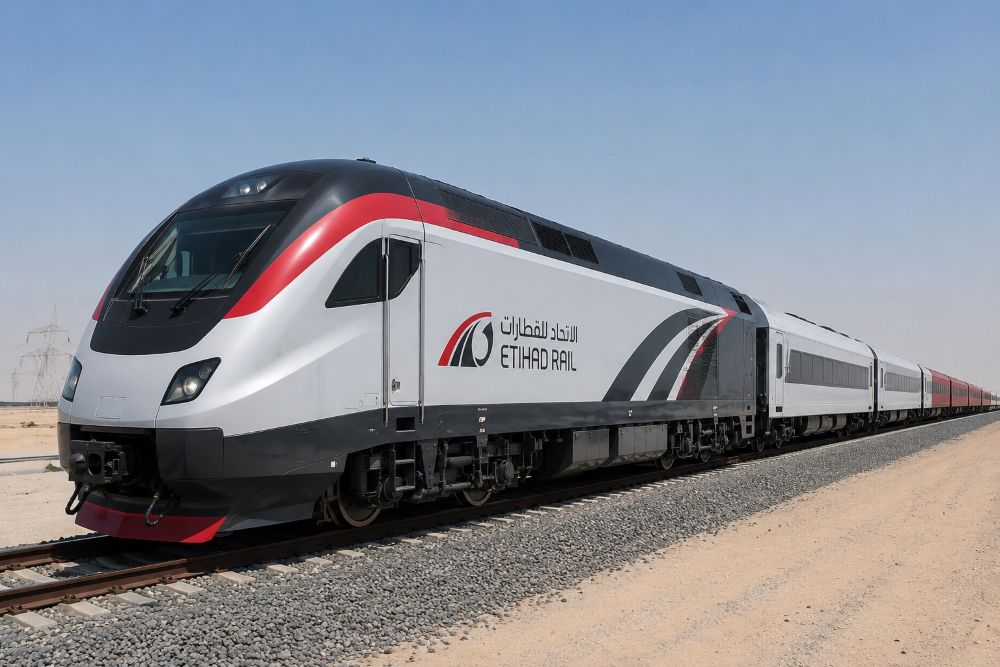
With passenger services officially making their historic inaugural cross-emirate trips from Abu Dhabi’s Mohamed bin Zayed City to Fujairah’s Al Hilal City, the network has transitioned from an ambitious engineering blueprint into a living, breathing economic engine.
Far more than a simple transportation upgrade, Etihad Rail represents critical national economic infrastructure. It is designed to restructure how businesses operate, how talent moves, and how value is created across the Seven Emirates.
1. Re-engineering National Logistics and Supply Chains
At its core, Etihad Rail is a game-changer for industrial efficiency. By seamlessly linking the country’s major maritime ports, manufacturing centers, and free zones, the freight and passenger network acts as a robust demand buffer and national supply chain stabilizer.
For logistics-heavy businesses, shifting bulk cargo from roads to rails offers massive operational advantages:
- Predictable Transit Times: Lower vulnerability to urban traffic congestion.
- Reduced Overheads: The ability to transport massive volumes of goods in a single journey significantly lowers per-ton transportation costs.
- Sustainability Credits: Rail transport substantially minimizes the carbon footprint of domestic freight, directly supporting the UAE’s long-term environmental and net-zero commitments.
2. The Real Estate “Rail Effect”
One of the most immediate and visible economic impacts of the network is what market analysts are calling the “Rail Effect.” Areas positioned along the rail corridor are experiencing a dramatic real estate transformation, shifting properties from “too far” to “next door.”
Recent market reports show property values and rental rates surging by up to 25% in neighborhoods located near new rail links. This connectivity is unlocking value in suburban and previously less-accessible communities, turning them into highly desirable residential and commercial pockets.
For property investors and developers, upcoming station areas present exceptional opportunities for long-term capital growth. We are already seeing transit-oriented master plans take shape, such as the mixed-use district surrounding Fujairah’s newly completed Sakamkam station. This zone is set to blend commercial venues, residential units, and advanced local mobility options like autonomous vehicles and integrated bus networks.
3. Amplifying Labor Mobility and De-centralized Growth
The economic lift of Etihad Rail isn’t confined to the traditional commercial powerhouses of Dubai and Abu Dhabi. By slashing travel times—reducing the commute between Abu Dhabi and Dubai to roughly an hour, and linking Dubai to Fujairah in just 90 minutes—the railway is democratizing economic opportunity.
This hyper-connectivity completely redefines labor dynamics:
- Expanded Talent Pools: Businesses can now recruit top talent from across the entire country without requiring employees to relocate. A professional can easily reside in a more affordable coastal area like Fujairah while commuting to an office in a major city center.
- Balanced Regional Investment: Smaller or more specialized emirates gain immediate exposure to global corporate travel and tourism. Visitors flying into major hubs can confidently explore the entire country via a reliable, premium rail network rather than navigating car rentals or long bus routes.
4. A Short-Term Buffer and Long-Term Launchpad
The rollout of passenger rail introduces a powerful catalyst for domestic tourism and business travel. Increased travel frequency across the country helps stabilize hospitality sectors, driving hotel occupancies and stimulating regional commerce even during volatile global market conditions.
In the long run, as the network prepares to scale further to 11 key stations and eventually integrate into a broader GCC-wide rail network, its macroeconomic footprint will only multiply. It places the UAE at the absolute center of cross-border trade, regional talent migration, and integrated commercial ecosystems.
Ultimately, Etihad Rail is not merely laying down tracks; it is building the foundational architecture for the UAE’s next half-century of diversified, sustainable economic growth. For forward-thinking business leaders, founders, and investors, the message is clear: the future of UAE commerce is officially on the move, and it’s running right on time.
Bibliography
- The National (News): Etihad Rail set to offer economic uplift to Fujairah, businesses say
- Delemon Technology: Etihad Rail Impact on Real Estate in the UAE
- Khaleej Times: From too far to next door: How Etihad Rail will reshape UAE property markets
- Etihad Rail Official Corporate Portal:
- The National (Opinion/Editorial): UAE passenger rail has arrived right on time
- ONG Real Estate: The Rail Effect: How Etihad Rail is Driving a 25% Surge in UAE Property Prices