Treating corporate ledgers as a casual afterthought is officially obsolete. Establishing meticulous accounting and bookkeeping Dubai enterprises require has transformed from a routine back-office task into an indispensable shield against aggressive tax enforcement. With the Federal Tax Authority deploying automated AED 10,000 penalties for missed registration deadlines, feeling uneasy about evolving corporate tax mandates or disordered historical records is completely understandable. Many business owners worry about falling out of step with statutory requirements without even realizing where the gaps lie.
Fortunately, you don’t need an expensive full-time CFO to secure total peace of mind and protect your bottom line. This guide reveals how to master UAE financial compliance, establish tax-optimized operating structures, and gain crystal-clear visibility into your business cash flow. Ahead, we walk through the latest statutory standards, critical record-keeping obligations, and practical systems designed to keep your company fully protected and primed for long-term growth.
Key Takeaways
- Understand how current statutory corporate tax mandates connect directly to your daily ledgers and why active alignment with Federal Tax Authority standards protects your enterprise.
- Discover how cloud platforms and digital audit trails elevate the professional accounting and bookkeeping dubai firms rely on for audit-ready compliance.
- Evaluate the cost and scalability advantages of partnering with an outsourced financial team compared to maintaining full-time in-house staff.
- Follow a clear, step-by-step 2026 compliance roadmap to audit your existing books, close documentation gaps, and ensure timely corporate tax registration.
- Learn how an Emirati-owned advisory partner simplifies the transition from company formation to proactive, long-term regulatory governance.
The 2026 UAE Financial Landscape: Why Compliance is Mandatory
Operating a company in the Emirates once permitted relatively informal financial oversight. Today, rigorous fiscal integration defines the commercial ecosystem. Following the widespread codification of corporate direct taxation, maintaining robust standards for accounting and bookkeeping dubai business leaders rely upon has shifted from an operational preference to a strict statutory necessity. Historical context on this shift, detailed in records on Taxation in the United Arab Emirates, illustrates how rapidly the region evolved from an indirect tax environment into a sophisticated, dual-tier fiscal framework.
Your daily financial journals now feed directly into tax calculations overseen by the Federal Tax Authority (FTA). Because taxable corporate income derives directly from your statutory commercial net profit, any ledger error distorts your tax returns. “Backlog accounting”—the risky habit of reconstructing a year’s worth of invoices weeks before an annual audit—is completely unviable in 2026. The FTA platform, EmaraTax, connects across banking registries, customs databases, and licensing portals. It flags timing discrepancies automatically. Clean, daily reconciliations are your first defense.
The Impact of UAE Corporate Tax on Standard Bookkeeping
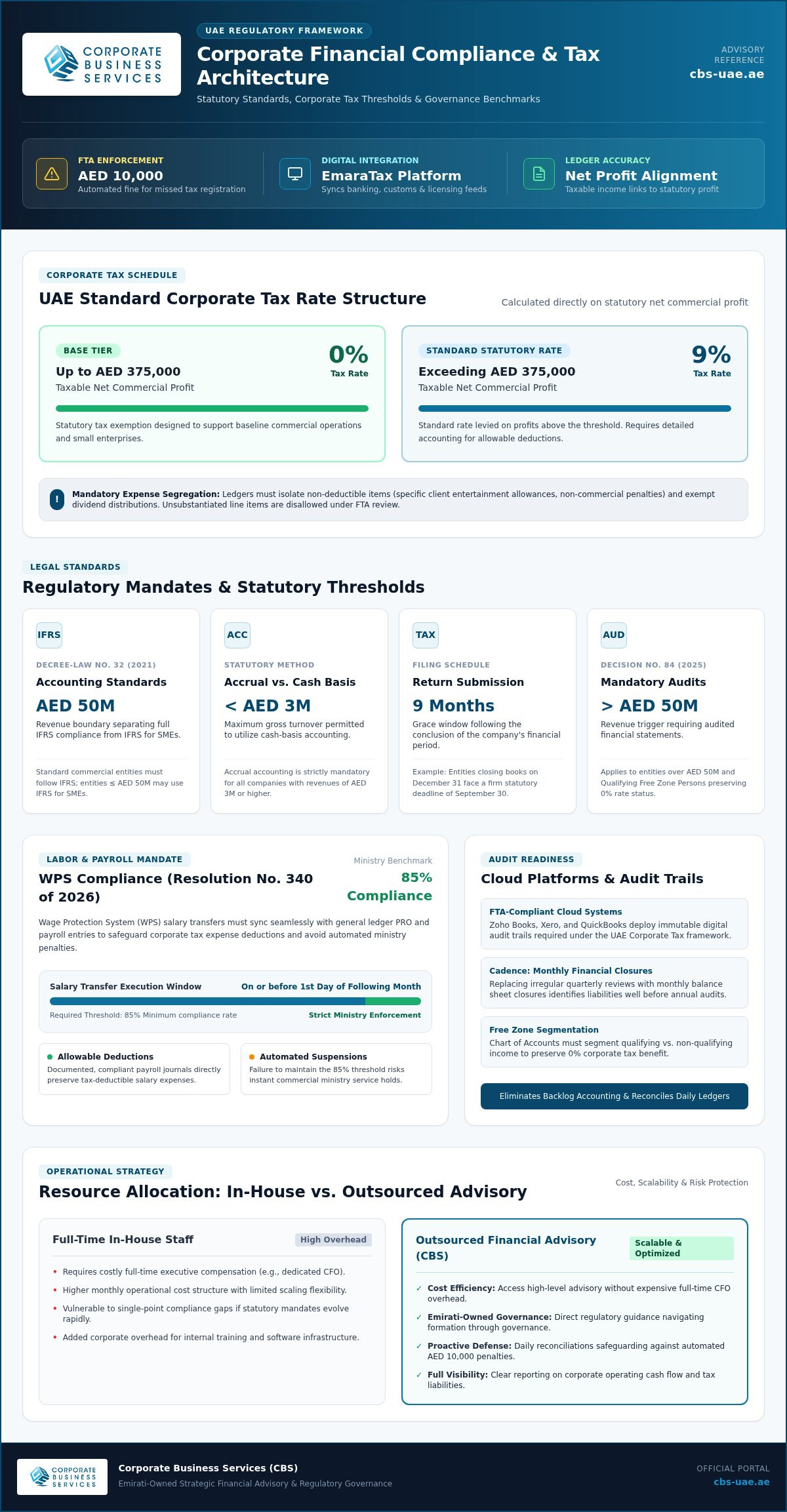
Modern ledgers demand granular expense categorization. Corporate Tax applies at a standard rate of 9% on taxable net profits exceeding AED 375,000, while profits up to that threshold are taxed at 0%. Calculating this balance requires isolating non-deductible expenses, such as specific client entertainment allowances and non-commercial penalties, alongside exempt dividend distributions. Unsubstantiated line items will be disallowed during an FTA review, artificially inflating your tax bill.
Regulatory Bodies and Standards to Know
The FTA possesses expansive audit powers, including the authority to inspect physical premises, issue binding revenue adjustments, and levy automated administrative fines for non-compliance. Navigating these checks requires adhering to clear technical benchmarks:
- Statutory Accounting Standard: Federal Decree-Law No. 32 of 2021 mandates IFRS for commercial entities, though businesses generating AED 50 million or less may implement IFRS for SMEs.
- Cash vs. Accrual Limits: Accrual accounting is mandatory across the board, with cash-basis ledgers strictly restricted to entities with gross turnover below AED 3 million.
- Filing Timelines: Corporate tax returns and liabilities must be submitted within 9 months following the close of your financial period; companies closing books on December 31 face a firm September 30 deadline.
- Audit Triggers: Ministerial Decision No. 84 of 2025 mandates audited financials for firms with annual revenues above AED 50 million and Qualifying Free Zone Persons aiming to preserve their 0% tax benefit.
Adopting an orderly approach to daily accounting and bookkeeping in Dubai ensures statutory compliance while providing transparent insights into your operating cash flow.
Essential Components of Professional Bookkeeping in Dubai
Treating financial records as mere administrative housekeeping leaves modern firms vulnerable during tax reviews. In practice, the high-caliber accounting and bookkeeping dubai organizations depend on functions as a proactive compliance engine rather than a rear-view mirror. Deploying FTA-compliant cloud software, such as Zoho Books, Xero, or QuickBooks, establishes the immutable digital audit trails required under the UAE Corporate Tax framework. Monthly financial closures, rather than irregular quarterly reviews, ensure your balance sheets reflect actual corporate tax liabilities well before year-end.
Operational bookkeeping must also sync directly with local labor rules. Under Ministerial Resolution No. 340 of 2026, Wage Protection System (WPS) salary transfers must be completed on or before the 1st day of the following month, maintaining a strict 85% compliance threshold. Integrating your PRO services and payroll journals directly into your general ledger prevents automated ministry suspensions while preserving clean salary documentation for allowable corporate tax deductions.
Chart of Accounts Customisation for UAE Industries
Your general ledger must mirror your actual corporate jurisdiction. Free zone entities require segmented accounts to separate qualifying from non-qualifying income, ensuring they don’t accidentally breach the de minimis threshold of 5% or AED 5 million that preserves their 0% tax tier. Mainland businesses require precise categorization to isolate recoverable input VAT from non-deductible expenses like executive entertainment. Structuring your accounts properly from day one ensures your records are fully prepared for corporate tax advisory UAE specialists to evaluate deductions accurately.
Bank Reconciliation and Documentation Management
Reconciling accounts in an international trading hub involves constant management of foreign exchange volatility. Realized and unrealized currency differences directly impact taxable operating profits under mandatory IFRS rules. Beyond automated bank feeds, maintaining verifiable documentation remains legally essential. Statutory frameworks mandate retaining corporate tax records for at least 7 years, alongside a 5-year retention rule for VAT documentation. If you want a frictionless method to organize these protocols, collaborating with Corporate Business Services helps establish audit-ready filing workflows right from the start.
Outsourced Accounting vs. In-house Teams: Making the Choice
Deciding between recruiting an internal finance department or partnering with an external firm impacts both your capital allocation and administrative exposure. Employing a resident accountant involves far more than baseline compensation. Sponsoring an employee in the UAE requires funding residence permits, mandatory health insurance coverage, and annual leave allocations, plus accruing end-of-service gratuity. Solo hires often function as generalists who can handle everyday data logging, but they rarely hold the technical tax acumen necessary to navigate official Federal Tax Authority Corporate Tax requirements.
External advisory firms address this capability deficit through shared infrastructure. Engaging professional accounting and bookkeeping dubai specialists instantly links your enterprise to seasoned tax practitioners and ERP system architects. This collaborative model scales smoothly alongside your business. Transaction spikes never create sudden operational bottlenecks, and client records remain guarded under strict non-disclosure agreements, enterprise-grade cloud permissions, and encrypted protocols.
When to Keep it In-house
Internal personnel make practical sense under particular operational conditions:
- High-Frequency Point of Sale: Establishments processing hundreds of distinct counter receipts, supplier manifests, or petty cash vouchers daily gain efficiency from immediate physical oversight.
- Direct Inventory Warehousing: Enterprises managing rapid physical stock turns benefit from an on-site controller monitoring stock reconciliations against floor adjustments.
- The Hybrid Balance: Many growing operations retain a junior clerk on-site for immediate document intake while assigning month-end closing, VAT filings, and balance sheet validation to an external partner.
The Advantages of Professional Outsourcing
Partnering with a specialized advisory eliminates the friction of recruiting, visa processing, and workspace allocation. More importantly, it insulates your corporate governance against sudden team departures or extended leave cycles, ensuring reporting continuity without costly interruptions. When evaluating your operating model, consider how these operational paths contrast:
| Operational Factor | In-House Accountant | Outsourced Advisory Firm |
|---|---|---|
| Core Capability | General ledger administration; variable tax insight | Comprehensive teams spanning bookkeeping, VAT, and Corporate Tax |
| Staffing Continuity | Disrupted by annual leaves, sick days, or resignations | Uninterrupted service backed by structured team coverage |
| Overhead Exposure | Visas, mandatory benefits, workstations, software fees | Consolidated operational costs without statutory employee overhead |
| Local Regulatory Access | Dependent on individual personal knowledge | Institutional familiarity with ministry channels and FTA protocols |
Selecting the right path for accounting and bookkeeping in Dubai depends on your workflow complexity, but external support reliably provides institutional stability without administrative strain.
A Step-by-Step Compliance Checklist for 2026
Executing systematic accounting and bookkeeping dubai enterprises rely on begins with a structured operational roadmap. Rather than scrambling at the close of the financial year, follow these sequential steps to maintain pristine compliance:
- Perform a Historical Gap Analysis: Review prior financial periods to identify missing tax invoices, unresolved debit balances, or unrecorded director withdrawals. Remediating discrepancies early prevents compounded reporting errors.
- Confirm Corporate Tax Registration: If you haven’t already registered via EmaraTax, do so immediately to prevent the automated AED 10,000 late-registration penalty. Qualifying first-year filers can utilize the FTA waiver by filing their initial tax return within 7 months of their period end.
- Deploy Certified Cloud Software: Transition away from spreadsheets to platforms capable of producing structured trial balances and accommodating the Ministry of Finance’s evolving electronic invoicing guidelines.
- Institutionalize a Monthly Closing Cycle: Reconcile all bank feeds, run payroll before the 1st of each month to satisfy WPS rules, and accrue tax liabilities monthly.
- Conduct Pre-Filing Ledger Audits: Cross-reference gross income reported on quarterly VAT returns against your corporate tax trial balance before final submission to eliminate red flags.
Preparing for the Annual Audit
Audited financial statements are legally required for companies generating revenues above AED 50 million, Corporate Tax Groups, and Qualifying Free Zone Persons defending their 0% tax tier. Preparing an audit-ready trial balance requires organizing supporting documentation for all capital additions, intercompany loan agreements, and lease liabilities. Unsubstantiated shareholder transactions and unverified asset write-offs represent the most frequent triggers for prolonged audit delays.
Managing VAT Returns and Refunds
Filing periodic VAT returns requires precise tracking of standard-rated, zero-rated, and exempt turnover. The most common error involves attempting to recover input tax on restricted operational expenses, such as corporate entertainment. When planning your business expansion or pursuing Mainland Company Formation in Dubai, configuring your VAT framework at the licensing stage prevents retroactive filing penalties. If excess tax credits accrue, submit your refund claim directly via the EmaraTax portal alongside digital supplier invoices and export declaration documents.
To eliminate compliance blind spots across your operations, schedule a compliance assessment with CBS to protect your business against administrative liabilities.
Strategic Financial Advisory with Corporate Business Services (CBS)
Mastering financial compliance across the Emirates requires more than technical software; it demands deep local mastery. As an Emirati-owned and operated consultancy, Corporate Business Services (CBS) acts as an authoritative navigator for international entrepreneurs and UK investors establishing regional footprints. We view financial governance as a natural extension of your company setup. Rather than coordinating separate vendors for commercial licensing, PRO tasks, and statutory filings, our one-stop model creates an effortless continuum. We guide your enterprise from its initial incorporation directly into the disciplined accounting and bookkeeping dubai regulations require.
Tailored Accounting Solutions for UAE Growth
Every commercial enterprise expands at its own pace. CBS constructs adaptable bookkeeping workflows that evolve alongside your operational volume, giving you immediate access to seasoned corporate tax specialists who protect your margins. We eliminate the administrative stress of local compliance so you can focus entirely on commercial expansion. For organizations scaling across regional borders, our advisors align your UAE financial framework with statutory filing mandates for business setup in Saudi Arabia, ensuring unified reporting across jurisdictions.
Partnering for Long-Term Success
True financial partnership moves well beyond historical ledger reconciliation. Our advisory team translates complex balance sheet data into clear commercial visibility, providing the confidence you need to make forward-looking investment choices. Because regulatory compliance connects directly with your corporate standing, our specialists coordinate the critical administrative functions that sustain your enterprise:
- Bank Account Opening Support: Streamlining institutional documentation to secure corporate banking relationships efficiently.
- Government Documentation: Managing official approvals, municipal clearances, and statutory renewals without operational friction.
- Corporate Tax Structuring: Structuring income streams to optimize deductions and satisfy all FTA requirements.
You don’t have to tackle shifting regulatory demands alone. Secure your commercial future and establish an audit-ready financial structure: Consult with CBS today to experience transparent, full-spectrum advisory.
Future-Proof Your UAE Enterprise for Sustainable Growth
Navigating the Emirates’ modernized financial framework doesn’t have to strain your day-to-day operations. Successfully maintaining the disciplined accounting and bookkeeping dubai authorities mandate comes down to establishing a proactive rhythm: deploying certified cloud software, enforcing consistent monthly reconciliations, and aligning routine entries with Federal Tax Authority standards. When your ledgers reflect genuine economic reality, audit anxieties disappear, replaced by dependable visibility over your working capital.
Corporate Business Services provides the seasoned local guidance your enterprise deserves. As an Emirati-owned consultancy, we deliver a seamless transition for international investors by integrating corporate structuring, comprehensive PRO workflows, and specialized corporate tax advisory under one unified roof. You don’t have to manage these technical transitions in isolation. Ensure your business is 2026-ready with CBS Accounting Services and build a resilient foundation for lasting commercial success.
Frequently Asked Questions
Is bookkeeping mandatory for all companies in Dubai in 2026?
Yes, maintaining proper books of account is a statutory obligation for every licensed entity under Federal Decree-Law No. 32 of 2021. Both mainland and free zone businesses must record all commercial transactions, assets, and liabilities using standard accrual methods. Operating without systematic books prevents legitimate corporate tax filings and exposes your organization to severe administrative penalties under Federal Tax Authority regulations.
What is the difference between accounting and bookkeeping in the UAE?
Bookkeeping handles the transactional foundation, capturing day-to-day invoices, supplier payments, bank entries, and payroll records. Accounting takes those balanced journals and applies statutory analysis, tax adjustments, and financial reporting under IFRS principles. For dependable accounting and bookkeeping dubai enterprises rely on, both functions work together to turn raw business data into audit-ready filings and strategic performance metrics.
Can I use international accounting software like QuickBooks in Dubai?
Yes, international platforms like QuickBooks, Xero, and Zoho Books work effectively provided they are configured for UAE statutory standards. Your chosen platform must support 5% VAT calculations, generate standard FTA audit files, and accommodate the Ministry of Finance’s ongoing electronic invoicing rollout. Cloud-based platforms also ensure secure remote access, automated bank feeds, and transparent multi-currency tracking for cross-border transactions.
How long must I keep my financial records under UAE law?
You must retain corporate tax records and supporting commercial documents for a minimum of 7 years from the close of the relevant tax period. Commercial companies law mandates keeping core ledgers for at least 5 years, while standard VAT records also require a 5-year retention window. Retaining invoices, bank statements, and contracts in a structured digital archive ensures rapid compliance during unexpected FTA inspections.
What are the penalties for non-compliance with UAE accounting standards?
Penalties escalate quickly depending on the specific regulatory breach. Missing the corporate tax registration window triggers an automated AED 10,000 fine via EmaraTax, while late VAT submissions begin at AED 1,000. Additionally, failing to maintain adequate financial records or omitting supporting documentation can prompt direct FTA audits, administrative financial penalties, and the immediate suspension of commercial licenses or work permits.
Do Free Zone companies need to pay Corporate Tax in 2026?
Free zone companies must register for corporate tax and submit an annual return, but they may qualify for a 0% rate on qualifying income. To secure this benefit as a Qualifying Free Zone Person, your enterprise must maintain adequate economic substance, satisfy the de minimis threshold on non-qualifying revenue, and obtain an annual external audit. Non-qualifying transactions are taxed at the standard 9% rate.
Should I hire a full-time accountant or outsource to a firm?
Outsourcing offers substantial operational and cost benefits for most small to mid-sized enterprises. Sponsoring an in-house hire involves ongoing overhead, including visas, health coverage, workstation costs, and end-of-service gratuities. By contrast, outsourcing your accounting and bookkeeping dubai operations connects you directly with a multidisciplinary team of tax professionals and accountants who scale their services alongside your commercial expansion without administrative drag.
How does VAT registration affect my bookkeeping requirements?
VAT registration requires maintaining precise, verifiable tax invoices with designated TRNs and detailed tax breakdowns. You must categorize all sales into standard-rated, zero-rated, and exempt transactions while separating recoverable operational input tax from blocked expenses like executive entertainment. Because the FTA requires digital audit trails for every filing, accurate real-time bookkeeping ensures seamless quarterly VAT reconciliations and hassle-free tax credit claims.