Running an enterprise in the United Kingdom has entered a new era. Managing small business accounting is no longer a casual administrative routine; it is your company’s frontline regulatory defence. With HMRC enforcing tighter compliance oversight, maintaining immaculate books is now mandatory for every registered entity.
You likely built your venture to pursue growth and serve clients, not to lose sleep untangling multi-currency payment gateways, deciphering corporate tax thresholds, or dreading surprise administrative penalties. Wondering whether to recruit an internal team or partner with an outsourced specialist like Corporate Business Services (CBS) only adds to that friction.
You don’t need to let financial reporting stall your commercial momentum. This guide provides a clear roadmap to master SME bookkeeping, fulfil corporate tax obligations, and protect your banking relationships with total confidence.
Here is your complete, step-by-step 2026 compliance checklist, structured to streamline your monthly accounting routines and keep your business permanently audit-ready.
Key Takeaways
- Understand the statutory mandates shaping small business accounting dubai founders must navigate across mainland and free zone jurisdictions.
- Learn how disciplined bookkeeping serves as the essential bedrock for accurate quarterly VAT returns and corporate tax filings.
- Compare the actual overheads of internal hires, including visa sponsorship and gratuity, against flexible outsourced advisory solutions.
- Implement a clear daily, monthly, and annual financial cadence to remain permanently audit-ready and avoid severe statutory penalties.
- Discover how transitioning from manual spreadsheets to structured accounting infrastructure protects commercial banking facilities and unlocks future investment.
Understanding Small Business Accounting in Dubai: Regulatory Mandates
The UAE financial ecosystem has transformed into a globally aligned, highly regulated market. Establishing professional small business accounting dubai operations is no longer merely an internal tracking routine; it is an explicit legal mandate. Under Federal Decree-Law No. 32 of 2021 on Commercial Companies, every registered commercial entity across mainland and free zone jurisdictions must maintain formal accounting records. Beyond statutory compliance, UAE financial institutions now routinely demand reconciled ledgers and financial summaries during periodic Know-Your-Customer (KYC) reviews. Without up-to-date accounts, businesses risk immediate operational disruption and frozen corporate bank accounts.
The Legal Obligation to Maintain Books of Accounts
UAE company law requires commercial entities to preserve their books of accounts at their head office for a minimum of five continuous years. Compliance requires preparing a complete set of financial statements, including a balance sheet, an income statement, and a cash-flow statement. Local authorities expect these reports to align with International Financial Reporting Standards (IFRS), though qualifying smaller enterprises can implement the simplified IFRS for SMEs framework. Failing to maintain these continuous accounting books exposes the company to severe operational risks, including heavy statutory fines and the suspension of your commercial trade license during annual renewal cycles.
Federal Tax Authority (FTA) Record-Keeping Standards
The Federal Tax Authority (FTA) enforces precise documentation standards that operate parallel to commercial company laws. Taxable entities must systematically archive all sales invoices, purchase receipts, debit notes, customs import declarations, and bank records for both taxable and exempt supplies. For corporate tax purposes, businesses must retain these records for at least seven years following the end of the relevant tax period.
To withstand an official audit, consider these FTA documentation requirements:
- Format and Accessibility: You can maintain digital accounting records via cloud platforms, provided documents are readily exportable, legible, and chronologically organized.
- Language Standards: While standard business records and cloud accounting software may operate in English, the FTA retains the legal authority to request certified Arabic translations of ledgers and source documents during an investigation.
- Audit Defense: Complete, verified transaction trails serve as your primary defense against arbitrary administrative penalties, which can quickly destabilize cash flow.
Maintaining a structured small business accounting dubai protocol ensures that your enterprise stays fully protected, compliant, and ready for regulatory inspections at any time.
The Core Financial Pillars: Bookkeeping, VAT, and Corporate Tax
Sound financial governance relies on a continuous chain of documentation. In the UAE, daily bookkeeping, quarterly Value Added Tax (VAT), and annual corporate tax obligations operate as a single connected system. Daily transaction logs feed into quarterly filings, which then establish the final net profit declared for annual statutory tax assessments. Treating tax compliance as an isolated year-end scramble guarantees errors, missed deductions, and administrative exposure. For an in-depth breakdown of corporate mandates, review our guide on navigating corporate tax advisory in the UAE.
Corporate Tax and Small Business Relief Requirements
The standard UAE corporate tax rate is 9% on taxable net profits exceeding AED 375,000, while net income up to that threshold is taxed at 0%. To protect emerging enterprises, the Ministry of Finance extended Small Business Relief (SBR) for tax periods ending on or before 31 December 2029. Resident entities with gross revenue below AED 3,000,000 in the relevant and prior tax periods can elect for SBR, treating their taxable profit as zero. However, relief is not automatic. You must actively elect for it on your return, and claimants cannot carry forward tax losses. Examine our corporate tax impact on UAE businesses analysis to structure your filings correctly.
Value Added Tax (VAT) Registration and Filing Thresholds
VAT applies at a standard 5% rate across most commercial supplies. Registration requirements hinge on specific revenue markers:
- Mandatory Threshold: Registration is compulsory if taxable supplies and imports exceed AED 375,000 over the preceding 12 months, or will cross that mark within 30 days. Late registration incurs an immediate AED 10,000 penalty.
- Voluntary Threshold: Businesses generating over AED 187,500 in taxable supplies or expenses may register voluntarily to reclaim input VAT.
- Tax Invoices: You must issue itemized tax invoices displaying your Tax Registration Number (TRN), unit prices, and explicit VAT amounts within 14 calendar days of supply. Quarterly VAT returns are due within 28 days following the end of the tax period.
IFRS Compliance for Small and Medium Enterprises
SME accounting in the Emirates mandates accrual-basis accounting under IFRS for SMEs. Cash-basis tracking obscures liabilities and fails statutory checks. Clean accrual accounting gives local banks the audited transparency required to extend credit lines and working capital facilities. If aligning these financial layers feels complex, collaborating with our team at Corporate Business Services (CBS) provides immediate regulatory clarity and peace of mind.
Mastering these three pillars ensures your small business accounting dubai setup operates smoothly, protecting your enterprise against unnecessary tax friction and unexpected audits.
In-House vs Outsourced Accounting for UAE Small Businesses
Every founder eventually faces a critical operational fork in the road: should you hire a dedicated accountant or outsource your books to a specialist firm? Modern cloud platforms like Xero and QuickBooks simplify routine data entry, but software alone cannot file tax returns, interpret complex FTA public clarifications, or defend your ledgers during an official review. Successful small business accounting dubai models blend practical software automation with seasoned human expertise. For an exhaustive exploration of operational structures, consult our definitive resource guide on accounting and bookkeeping in Dubai.
The True Cost of In-House Accounting Staff
Employing an internal finance manager involves expenses that reach well beyond baseline monthly salaries. Founders must fund UAE employment visa processing, mandatory private health insurance policies, annual flight allowances, and statutory end-of-service gratuity provisions required under UAE Labour Law. Additional office desk space, dedicated computing hardware, and multi-user software licensing add significant recurring overhead.
Hiring internally also introduces operational vulnerabilities:
- Single-Point Dependency: Relying on a single individual means reconciliations stall entirely during annual leave, sick days, or sudden resignations.
- Skill Gaps: A junior bookkeeper proficient in data entry often lacks the advanced technical mastery required to manage corporate tax adjustments or cross-border VAT treatment.
- Training Lag: Continuous regulatory updates force founders to invest significant executive time and capital into ongoing staff training.
Strategic Benefits of Outsourced Corporate Advisory
Partnering with an external consultancy delivers institutional-grade financial oversight without fixed employment overheads. Service arrangements scale fluidly alongside your transaction volumes, preventing cash burn during seasonal business dips. Your company gains immediate access to a complete department of corporate tax advisers, senior auditors, and payroll specialists for less than the fully loaded cost of a single full-time employee.
Outsourcing establishes a multi-tiered review structure where independent senior reviewers audit every ledger before statutory submission. This segregation of duties minimizes data-entry errors, strengthens governance, and shifts ongoing compliance liability away from the business owner. Founders regain critical working hours to focus on commercial expansion, customer acquisition, and strategic execution.
Selecting the right administrative model defines how efficiently your business navigates statutory filings while safeguarding long-term profitability.
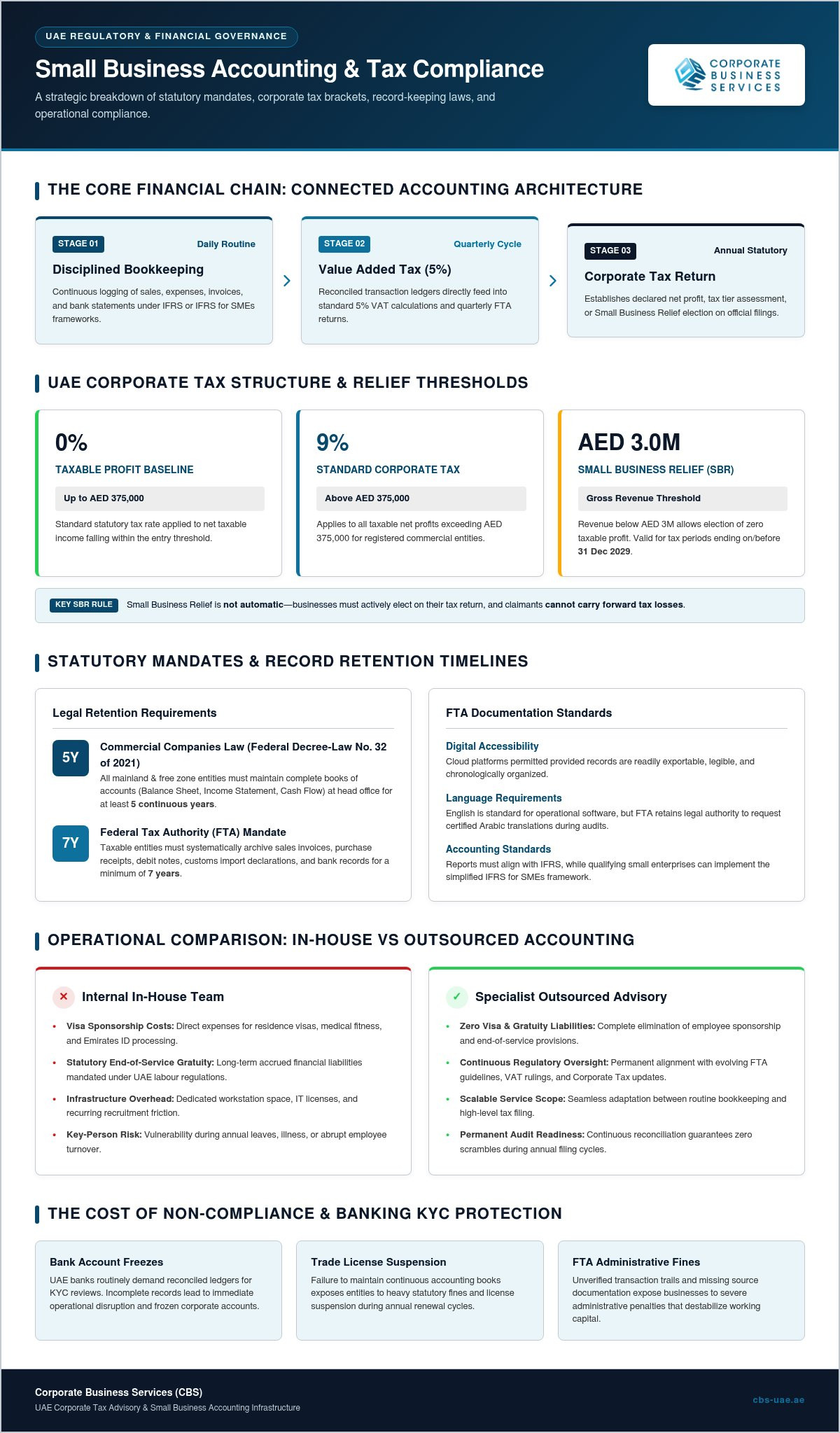
The Small Business Accounting Checklist for Dubai Founders
Operational discipline separates thriving enterprises from those blindsided by tax audits. Establishing a structured checklist for small business accounting dubai transforms financial governance from a chaotic scramble into a predictable routine. The foundation begins with a strict operational rule: segregate personal and commercial transactions completely. Commingling funds complicates deductible expense calculations, distorts profit margins, and triggers immediate red flags during corporate bank compliance reviews.
Daily and Monthly Bookkeeping Checklist
Consistent daily habits eliminate severe month-end bottlenecks. Capture every transaction immediately, ensuring digital receipts feature complete vendor details and tax metadata.
- Daily: Record customer invoices, log incoming payments, and archive valid supplier VAT invoices.
- Monthly Bank Reconciliation: Reconcile all commercial bank accounts, corporate credit cards, and multi-currency merchant gateways down to the exact dirham.
- Monthly Payables and Receivables: Review aged debtor reports to accelerate cash collection, and evaluate aged creditors to protect operational working capital.
- Monthly Payroll: Execute staff wage disbursements through the mandatory UAE Wages Protection System (WPS) to maintain full regulatory alignment.
Quarterly VAT and Reporting Review
Every quarter demands rigorous verification before submitting figures through the FTA EmaraTax portal:
- Tax Verification: Reconcile output VAT collected against valid input VAT claimed, checking that every deduction is supported by a compliant tax invoice.
- Ledger Alignment: Compare taxable, zero-rated, and exempt supplies against general ledger revenue figures to ensure perfect alignment.
- Statutory Submission: Submit quarterly VAT returns and execute outstanding payments within 28 days following the end of the tax period to avoid automatic late penalties.
Annual Corporate Tax and Audit Preparation
Closing the financial year requires converting day-to-day books into statutory annual reports. Calculate asset depreciation, reconcile physical inventory valuations under IFRS standards, and identify non-deductible adjustments, such as administrative fines and the statutory 50% restriction on client entertainment expenses. Determine whether your revenue qualifies for Small Business Relief before compiling finalized statements for tax return submission within nine months of your financial year-end.
If you want to establish an airtight compliance routine without administrative strain, schedule a compliance consultation with Corporate Business Services to secure your financial operations.
Adhering to this operational timetable ensures your business remains permanently audit-ready, protects commercial banking relationships, and positions your firm for sustainable growth.
Building a Resilient Financial Infrastructure for Growth
Relying on disconnected spreadsheets might seem convenient during the initial setup phase, but it quickly becomes an operational hazard as transaction volumes expand. Manual workbooks don’t provide verifiable audit trails, and they fail to satisfy commercial lenders or institutional investors. Pristine small business accounting dubai infrastructure transforms financial data into a strategic asset. Clean ledgers safeguard your corporate banking facilities against compliance freezes and provide the verified track record needed to secure commercial debt or private equity.
Implementing Cloud Accounting and Digital Banking
Modernising your financial operations requires a methodical technological foundation:
- Deploy Compliant Software: Implement FTA-accredited cloud platforms such as Xero or Zoho Books to guarantee automated data backups and strict version control.
- Integrate Direct Bank Feeds: Connect UAE commercial corporate bank accounts directly to eliminate manual statement imports and transcription errors.
- Structure a Localized Chart of Accounts: Tailor your ledgers specifically around your licensed business activities to categorize revenue streams and direct operating costs accurately.
- Standardise Automated Billing: Configure invoicing engines with pre-populated Tax Registration Numbers (TRNs) and mandatory payment terms to ensure immediate compliance.
Mitigating FTA Audit Exposure and Penalty Risks
Audit defense requires proactive operational checks rather than year-end damage control. Maintain an unbroken digital paper trail connecting every bank debit to an itemized invoice, bill of lading, or contract. In addition, address settlement discrepancies across payment gateways like Stripe or local merchant terminals every month. Unreconciled gateway fees and foreign exchange variances distort taxable net income, leaving your firm exposed to reassessment penalties during official tax audits.
Partnering with an Emirati Corporate Advisory
Aligning ongoing bookkeeping with statutory governance demands deep procedural fluency. Collaborating with an established Emirati-owned consultancy ensures your operational licenses, corporate structure, and tax filings remain completely synchronized. Seasoned corporate advisors provide the forward-looking oversight needed to adjust financial strategies as UAE regulations evolve, freeing you to scale your enterprise with confidence.
Master Your Financial Governance and Accelerate Growth
Navigating the UAE corporate landscape requires precision, foresight, and disciplined record-keeping. Establishing robust small business accounting dubai systems isn’t just about dodging statutory penalties; it creates the operational transparency needed to preserve corporate banking relationships and attract future capital. With daily reconciliations feeding quarterly VAT filings and annual corporate tax declarations, structured financial management keeps your enterprise permanently audit-ready.
You don’t have to tackle evolving regulatory requirements alone. As a 100% Emirati-owned consultancy providing comprehensive corporate compliance, Corporate Business Services offers an integrated advisory approach bridging commercial licensing, accounting, and Federal Tax Authority mandates. Backed by a proven track record of supporting entrepreneurs through seamless financial structuring, our team protects your company’s interests at every milestone.
Take control of your balance sheet today. Ensure Your Financial Compliance with CBS Accounting Experts and build a resilient foundation for long-term commercial success.
Frequently Asked Questions
Is accounting mandatory for small businesses and startups in Dubai?
Yes, formal accounting is legally mandatory for all commercial entities operating in Dubai. Federal Decree-Law No. 32 of 2021 mandates that every registered mainland and free zone business maintain comprehensive books of accounts. Beyond commercial legislation, the Federal Tax Authority requires verifiable financial records to substantiate tax declarations. Proper accounts are also essential during periodic corporate bank compliance reviews and commercial trade license renewals.
What is the corporate tax rate for small businesses in the UAE?
The UAE applies a standard corporate tax rate of 9% on taxable net profits exceeding AED 375,000. Any taxable net profit up to AED 375,000 is taxed at 0%. This operates as a tiered bracket, meaning you only pay 9% on the profit generated above that threshold. Additionally, eligible businesses with gross revenue below AED 3,000,000 can elect for Small Business Relief to reduce their net tax liability to zero.
Do businesses that qualify for Small Business Relief still need to keep accounts?
Yes, qualifying for Small Business Relief does not exempt your company from mandatory bookkeeping. The Federal Tax Authority requires relief beneficiaries to maintain complete financial accounts to substantiate that revenue remained below the AED 3,000,000 threshold. You must register for corporate tax, submit an annual tax return electing for relief, and retain supporting records. Neglecting record-keeping can forfeit your relief status and trigger immediate statutory fines.
What accounting records must an SME maintain to remain compliant with the FTA?
An SME must preserve general ledgers, sales invoices, purchase receipts, debit and credit notes, and monthly bank statements. Structuring small business accounting dubai operations requires retaining customs import documents, fixed-asset registers, inventory counts, and payroll slips processed via the Wages Protection System. Every transaction must feature a traceable audit trail, confirming that declared revenue matches your banking records and statutory tax returns.
Can I do my own small business bookkeeping using basic spreadsheet software?
While spreadsheets are technically permissible for basic tracking, they do not meet modern compliance expectations. Manual workbooks lack automated audit trails, version control, and real-time bank feeds, leaving your books vulnerable to human error. UAE authorities expect reliable records prepared under IFRS or IFRS for SMEs. Transitioning to certified cloud software ensures data integrity and drastically reduces preparation time during official tax audits.
How long must small businesses retain accounting documents under UAE law?
UAE commercial companies law requires businesses to maintain accounting records for a minimum of five continuous years. For corporate tax and VAT purposes, the Federal Tax Authority mandates a retention period of at least seven years from the end of the relevant tax period. Real estate-related records require retention for fifteen years. Storing digital copies securely in accredited cloud archives satisfies these legal inspection requirements.
What happens if a company fails to maintain accurate financial accounts in the UAE?
Failing to maintain accurate financial accounts exposes your enterprise to substantial administrative penalties and operational disruption. The Federal Tax Authority imposes severe fines for improper record-keeping and inaccurate filings, starting at AED 10,000 for specific compliance breaches. Continued non-compliance can prompt the suspension of your commercial trade license, block visa renewals, and lead commercial banks to freeze corporate banking facilities.
What is the difference between mainland and free zone accounting obligations?
Both mainland and free zone entities share the same statutory obligation to maintain accurate IFRS-compliant books of accounts under federal tax laws. The primary difference lies in audit enforcement. Many free zone authorities require annual audited financial statements for license renewal, whereas mainland SMEs generally require audited statements only if revenues exceed statutory thresholds or when applying for bank credit. Professional small business accounting dubai advisory ensures both company types stay fully compliant.