What if the biggest risk in outsourcing your books isn’t the provider you choose, but work nobody has clearly agreed to own? For companies considering outsourced bookkeeping for Dubai companies, external support can help with routine finance tasks, but responsibilities, records and review processes need to be clearly defined first.
It’s reasonable to want consistent reconciliations and dependable reporting while retaining control of sensitive financial information. Corporate Business Services (CBS) notes that an external bookkeeper may handle agreed tasks such as recording transactions or preparing reconciliations, while your team retains oversight of approvals, access and business decisions. The split depends on your needs and the provider’s confirmed scope, so settle assumptions before work begins.
This practical 2026 guide explains which bookkeeping tasks you might outsource, what to assess when comparing providers, and how to establish clear processes for records, software access, communication and escalation. It also covers review responsibilities and how to clarify whether bookkeeping connects with related tax support. A structured handover and agreed checks can make outsourcing a more organised part of your company’s financial operations.
Key Takeaways
- Understand what outsourced bookkeeping for Dubai companies can cover, and where bookkeeping ends and tax advice, audit work or management decisions begin.
- Use a clear, illustrative workflow to plan the handover, while confirming that each provider’s processes may differ.
- Compare providers by scope, communication, review arrangements, access and escalation. Separate confirmed inclusions from optional work.
- Prepare records, named contacts and approval steps before onboarding. Consistent file names and clear transaction details can reduce follow-up.
- CBS lists Accounting & Bookkeeping / Audit Services. Confirm the specific bookkeeping scope and working arrangements directly before proceeding.
What outsourced bookkeeping means for Dubai companies
For a company, outsourced bookkeeping means an external provider maintains financial records and carries out processes that both parties have agreed on. The key word is agreed: outsourcing defines who performs specific work; it doesn’t automatically transfer every finance responsibility. In plain language, outsourced bookkeeping is an arrangement in which an external provider maintains a company’s agreed financial records and bookkeeping processes.
Bookkeeping is the systematic recording and organisation of financial transactions. It helps a company understand its financial records, but it isn’t the same as accounting advice, an audit or tax services. Those activities may involve different analysis, assurance or specialist advice, and should be discussed and agreed separately. Bookkeeping also doesn’t make management decisions. The company remains responsible for decisions such as approving expenditure or setting budgets.
That distinction matters when assessing outsourced bookkeeping for Dubai companies. A provider may carry out agreed record keeping, while the company retains oversight of the information supplied, approvals and decisions made using the records. The exact division depends on the engagement. Don’t rely on assumptions or treat a task list as a substitute for professional advice on accounting, tax or audit matters.
Which bookkeeping activities might be included?
Possible examples include recording transactions and reconciling records against supporting information. Invoice handling, expense coding and report preparation may also be discussed, but they aren’t automatic inclusions. Providers differ, and CBS lists Accounting & Bookkeeping / Audit Services without specifying its bookkeeping deliverables. Before engaging a provider, request a written task list that states what’s included, what’s excluded and which tasks need separate agreement.
What remains the company’s responsibility?
The company needs to provide complete, accurate source documents in time for the agreed work. Depending on the scope, these might include invoices, receipts and bank records. Missing or late information can leave transactions unclear, so establish how documents will be supplied and who to contact when something is unavailable.
Appoint an authorised company contact to review records, answer questions and raise discrepancies. If a recorded payment doesn’t match the company’s own records, for example, the contact should flag it for investigation rather than assume the issue is resolved. Agree who can approve transactions and how unresolved questions will be escalated. These arrangements support oversight, but they don’t replace professional advice when a judgement or specialist service is needed.
How an outsourced bookkeeping workflow can operate
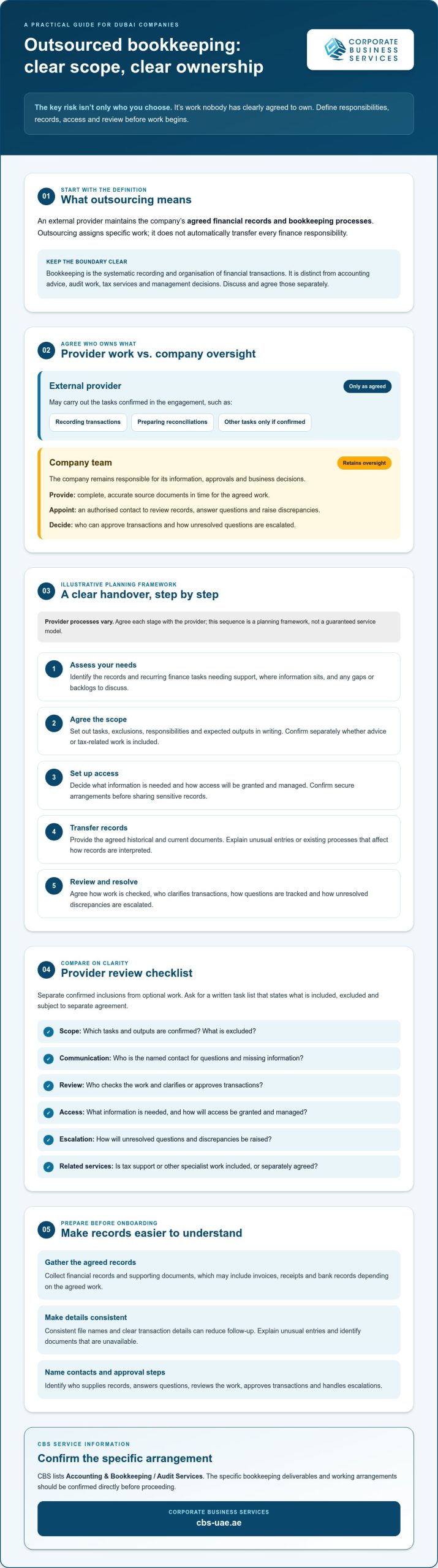
Provider processes vary, so treat the sequence below as a planning framework, not a guaranteed service model. Agree each stage with the provider before transferring records. A practical summary is: assess your needs, define the scope, arrange appropriate access, transfer records, then review the work and resolve queries through an agreed process.
- Assess your needs. Identify the records and recurring finance tasks you want help with, where information currently sits, and any gaps or backlogs to discuss.
- Agree the scope. Set out tasks, exclusions, responsibilities and expected outputs in writing. Confirm separately whether advice or tax related work is included or needs its own agreement.
- Set up access. Decide what information the provider needs and how access will be granted and managed. Confirm the arrangements securely before sharing sensitive records, without assuming a particular software platform.
- Transfer records. Provide the agreed historical and current documents, along with explanations of unusual entries or existing processes that affect how records are interpreted.
- Review and resolve. Agree how the work will be checked, who approves or clarifies transactions, how questions will be tracked and how unresolved discrepancies will be escalated.
For broader grounding in the underlying process, see this guide on the fundamentals of bookkeeping. The practical lesson is to build the handover around your company’s records and decision making, rather than simply adopting the provider’s preferred workflow.
What to prepare before onboarding
Gather existing financial records, supporting documents and a short description of current processes. List the people who can answer questions, approve transactions or clarify an entry, and specify what each person is authorised to do. Before sending sensitive information, confirm the transfer method and required access with the provider. A clear starting point helps both sides identify missing records and agree how to handle them.
How to keep records and queries moving
Agree how documents will be submitted, how incomplete records will be flagged and who owns each query. Choose communication channels and escalation steps in advance, including who to contact if an issue remains unresolved. Keep bookkeeping scope separate from specialist advice. If you need help assessing corporate tax matters, review the corporate tax advisory guide and clarify that work separately.
For outsourced bookkeeping for Dubai companies, a defined workflow makes responsibilities visible while preserving the company’s oversight. If you’re assessing your requirements, you can discuss bookkeeping needs with CBS. Confirm the specific scope and arrangements directly, as its service information doesn’t detail individual workflow stages.
How to compare outsourced bookkeeping providers
A polished proposal is useful only if it explains how the work will be managed. Compare providers against the same practical criteria, and ask for specific written answers instead of relying on broad claims about comprehensive support. The framework below helps distinguish confirmed inclusions from tasks that need separate agreement.
| Area | What to confirm | What to clarify |
|---|---|---|
| Scope | Which records and recurring tasks are included? | Are invoice handling, expense coding or reports excluded or separately agreed? |
| Communication | Who is your day to day contact, and which channels are used? | Who owns each query, and how are unanswered questions escalated? |
| Review | Who checks the work, and how are corrections recorded? | How are missing documents and unusual transactions flagged for your approval? |
| Access | What information or system access is needed, and how is it managed? | Who can view or change records, and how are access changes handled? |
| Escalation | How are discrepancies or unresolved issues raised? | Who makes the final decision when a transaction needs clarification? |
These questions matter when considering outsourced bookkeeping for Dubai companies because the working arrangement should fit both the records involved and your internal approval process. Keep bookkeeping scope separate from tax advice. For questions about the legal framework, consult the official text of Federal Decree-Law No. 47 of 2022 and seek appropriate professional guidance on how it applies to your circumstances.
Questions to ask before appointing a provider
Ask the provider to list the records and recurring tasks covered, identify who reviews the work, and explain how questions, corrections and access are managed. Request written terms that specify exclusions, each party’s responsibilities and how changes to scope will be agreed. If an answer is vague, ask for a practical example of how the process would work in your company.
How to assess fit for your company
Consider the complexity of your transactions, the condition of your existing records and how much time your team can give to approvals and queries. A proposed service should match those needs, not just sound extensive. Check that its communication approach suits your internal decision making. If your requirements are changing during formation, you may also want to compare UAE free zone and mainland setup considerations.
Verify promotional claims, ratings and credentials using current, relevant evidence. Ask what a claimed qualification covers and whether it applies to the people who would handle your work. CBS lists Accounting & Bookkeeping / Audit Services, but its available information doesn’t confirm specific bookkeeping tasks or controls. Confirm the proposed scope and arrangements directly before comparing providers.
How to prepare your company for outsourced bookkeeping
A careful handover starts before the provider receives any records. Take stock of what exists, how information is stored and who in your company understands each part of the process. This gives you a basis for defining the work and identifying gaps before routine responsibilities are assigned.
Use this checklist to prepare:
- Gather records: Collect available financial records and supporting documents, and note any missing or incomplete items.
- Map current processes: Record how transactions and documents are handled now, including recurring steps or known problem areas.
- Name key contacts: Identify who can submit records, answer queries, clarify transactions and approve exceptions.
- Agree secure exchange: Confirm with the provider how information will be shared and what access is needed before transferring sensitive material.
- Set a review approach: Decide who in your company will check outputs and how discrepancies will be raised and resolved.
Review existing records before recurring work begins. Check whether key documents can be matched to the transactions they support, and flag unclear entries or gaps for discussion. Consistent file names, such as a date and supplier or purpose, make documents easier to locate. Clear transaction descriptions also help explain what a payment relates to, reducing avoidable questions and follow-up.
Set up clear internal controls and approvals
Separate responsibilities where practical. The person who submits a document, for example, may not be authorised to approve an exception. Write down who owns each step, how the company will review agreed outputs and who handles discrepancies that need a decision. Confirm access permissions and information security practices with the provider, including who needs access and how changes will be managed.
Connect bookkeeping scope with wider business needs
Routine record keeping doesn’t automatically include tax advice, audit work, payroll or other advisory requirements. List related needs as questions and confirm whether each is in scope or requires a separate arrangement. This is useful when planning outsourced bookkeeping for Dubai companies, as the company’s wider finance requirements may affect the scope it needs to discuss.
Once you’ve assessed your records, contacts and approval process, you can discuss your bookkeeping requirements with CBS. CBS lists Accounting & Bookkeeping / Audit Services, but its available service information doesn’t specify individual bookkeeping tasks, software or review arrangements. Confirm the proposed scope and working practices directly before proceeding.
Discuss outsourced bookkeeping support with CBS
A productive service discussion starts with your requirements, not assumptions about what a provider includes. Before considering outsourced bookkeeping for Dubai companies, organise your needs around six areas: scope, people, processes, access, review and escalation. These help clarify what work you want to explore, who will be involved and how questions or discrepancies should be handled.
CBS lists Accounting & Bookkeeping / Audit Services. Its available service information doesn’t specify particular bookkeeping tasks, software, reporting frequency, review procedures or access controls. Use the conversation to establish fit: explain your current process, then ask what scope CBS can confirm and what responsibilities or service terms would apply. Keep tax or audit requirements separate unless they are discussed and agreed.
What to include in an initial enquiry
A concise, factual overview can make it easier to discuss your requirements. You don’t need to resolve every process detail first, but share enough context for the provider to understand your starting point:
- Current process: Explain how records are maintained now and which tasks you want to explore outsourcing.
- Records and software: Note the types of records available, where they’re held and any software currently used. Don’t assume the provider supports a particular platform.
- Internal roles: Identify who supplies documents, answers questions, reviews work and approves transactions or exceptions.
- Known challenges: Flag missing records, unclear entries, backlogs or steps that regularly create follow-up.
- Questions for CBS: Ask which tasks are available, what remains your responsibility, how access and review are handled, and which written service terms would apply.
Request a clear description of confirmed inclusions and exclusions before deciding whether the proposed arrangement suits your company. This helps prevent a service category from being mistaken for a specific deliverable.
When to review or adjust the arrangement
Revisit the agreed scope if transaction patterns change, internal contacts or approval roles shift, or your reporting needs develop. A new process or business activity may call for a fresh discussion about whether existing arrangements still match the work required. Don’t rely on informal assumptions. Agree how proposed changes will be documented, who must approve them and when they take effect.
Clear terms also make it easier to review the working relationship. Discuss whether queries are reaching the right person, whether responsibilities remain understood and whether the review process is identifying issues that need attention. Don’t treat general promotional claims as promises of particular response times, savings or compliance outcomes. Ask for the specific terms that apply to your proposed engagement.
If you’ve prepared your requirements and want to explore whether CBS’s listed services may fit, contact CBS to discuss your bookkeeping needs. Share your current processes and ask the team to confirm the available scope and service terms directly.
Build a bookkeeping arrangement with clear expectations
Outsourced bookkeeping for Dubai companies works best when scope, responsibilities and review processes are agreed in advance. Confirm which tasks are included, who supplies and checks records, how access is managed, and how missing documents or discrepancies will be escalated. A written understanding helps your team and provider work from the same expectations.
Before choosing a provider, assess your existing records and internal capacity. Compare proposals based on the actual service scope and working arrangements, not broad claims. Keep bookkeeping separate from related tax or audit support, and confirm whether those services are relevant to your requirements.
CBS lists Accounting & Bookkeeping / Audit Services, with VAT & Corporate Tax Services listed as a separate category. Its available information doesn’t specify particular bookkeeping tasks or service terms, so discuss your needs and confirm the proposed scope directly. Discuss your bookkeeping requirements with CBS to clarify what your company needs and the support CBS can confirm.
Frequently Asked Questions
What is outsourced bookkeeping for a company?
It’s an arrangement in which an external provider performs bookkeeping tasks agreed with the company. The scope can vary, so confirm which records, processes, reviews and reports are included instead of assuming there is a standard service. The company still needs to provide accurate information, oversee the relationship and clarify responsibilities in writing. For outsourced bookkeeping for Dubai companies, a documented scope helps both parties understand who handles each task.
Which bookkeeping tasks can a company outsource?
A company may outsource recurring record keeping or related administrative tasks, depending on the provider’s confirmed scope. Don’t assume reconciliations, invoice processing, payroll, tax advice or reporting are automatically included. Before transferring work, request a written list of deliverables and exclusions, along with details of required documents and approval responsibilities. This helps distinguish routine bookkeeping from specialist services or decisions that remain with the company.
How do I choose an outsourced bookkeeping provider?
Compare providers on confirmed scope, communication, review processes, access controls, query handling and written terms. Ask who performs and reviews the work, what happens when information is missing, and how changes to the arrangement are approved. Then assess whether the proposed service fits your records and internal approval process. Clear answers are more useful than broad service descriptions because they show how the working relationship is expected to operate.
Is outsourced bookkeeping suitable for a small company?
It may suit a small company seeking external support with agreed bookkeeping tasks, but suitability depends on transaction complexity, internal oversight and the provider’s actual scope. First identify which tasks need support and who in your company can supply, review and approve information. Then compare that list with the provider’s written terms. Don’t assume a standard package exists or that outsourcing removes the need for company oversight.
How do companies protect financial information when outsourcing bookkeeping?
Before onboarding, discuss authorised access, secure document exchange, user permissions, query handling and the provider’s information security practices. Confirm who may view or change records and how access will be reviewed if responsibilities change. Ask the provider to explain the safeguards and processes that apply to your proposed arrangement. Don’t assume a particular control is included; document what both parties agree before sharing sensitive financial information.
Does outsourced bookkeeping include tax or audit services?
Not necessarily. Bookkeeping, tax services and audit services can be separate activities, even when one provider lists them together. Ask which services are included in the proposed engagement, which need a separate agreement, and who is responsible for each task. CBS lists Accounting & Bookkeeping / Audit Services and VAT & Corporate Tax Services as separate service categories. Confirm specific inclusions directly, as the listed categories don’t establish the exact scope.
What should I prepare before outsourcing bookkeeping?
Gather available financial records, supporting documents, notes on existing processes and a list of recurring issues or questions. Identify the people who can submit records, answer queries and approve exceptions. Note the software and access arrangements currently in use, but confirm compatibility and permissions with the provider. This preparation gives both parties a clearer basis for discussing scope without assuming every existing process or task will transfer unchanged.