A trade licence doesn’t guarantee a bank account. If you’re seeking a corporate bank account for non residents in the UAE or Saudi Arabia, the key challenge is showing that your company, ownership structure and source of funds meet the bank’s compliance expectations. Detailed KYC checks, questions about physical presence and uncertainty about approval times can all make the process feel difficult to navigate.
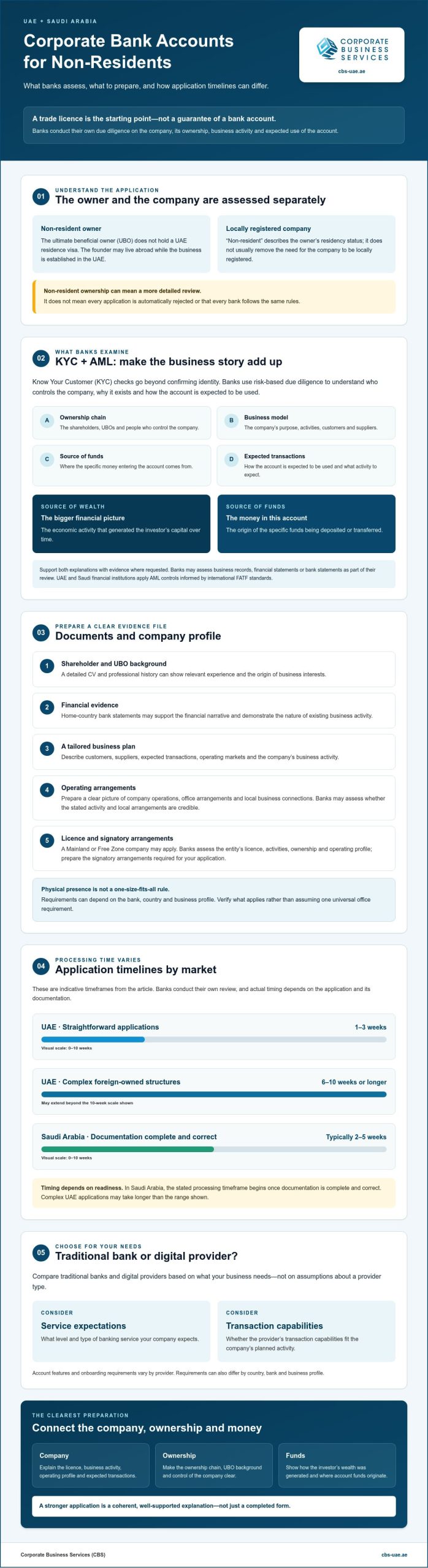
Success depends on more than submitting forms. Banks conduct their own due diligence, and requirements can differ by country, bank and business profile. In the UAE, straightforward applications may take one to three weeks, while complex foreign-owned structures can take six to ten weeks or longer. In Saudi Arabia, processing typically takes two to five weeks once documentation is complete and correct.
This 2026 guide explains how non-resident applications work in both markets, which documents and signatory arrangements to prepare for, and how compliance requirements shape the process. You’ll also learn how company formation and bank account opening support can help you prepare a stronger application and approach the process with greater clarity.
Key Takeaways
- A trade licence is only the starting point; a bank conducts its own review of the company, ownership and business activity.
- Learn how KYC and AML checks shape applications for a corporate bank account for non residents in the UAE and Saudi Arabia.
- Compare traditional banks and digital providers based on your needs, including service expectations and transaction capabilities.
- Prepare a clear profile of your company’s operations, office arrangements and local business connections before applying.
- See how coordinated company setup and bank account opening support can help you prepare a more complete application.
Understanding Corporate Bank Accounts for Non-Residents in the UAE
A corporate bank account for non residents is an account held by a locally registered company whose ultimate beneficial owner (UBO) does not have a UAE residence visa. The company and its owner have different statuses: a founder can live abroad while the business is established in the UAE. That distinction matters because the bank assesses the company’s activity and ownership, as well as the people who control it.
Non-resident ownership can lead to a more detailed review, but it does not mean every application is automatically rejected or subject to the same rules. Banks apply risk-based checks aligned with anti-money laundering (AML) obligations, examining factors such as the source of funds, ownership chain, business model and expected transactions. For a neutral introduction to Know Your Customer (KYC) compliance standards, see this foundational overview of customer identity checks. Compared with a resident-owned business, a non-resident applicant may need to provide more evidence. Account features and requirements still vary by bank.
International entrepreneurs often consider the UAE for access to regional markets and a tax framework that may suit their business structure. Tax efficiency is not automatic: as of September 2026, the standard UAE corporate tax rate is 0% on taxable income up to AED 375,000 and 9% above that threshold. Qualifying Free Zone Persons are subject to separate conditions for qualifying income. Consider banking, licensing and tax decisions together.
The Legal Framework for International Investors
The UAE Central Bank supervises financial institutions and sets regulatory expectations for areas such as AML and customer due diligence. Individual banks translate these expectations into their own onboarding policies. A Mainland company and a Free Zone company may each apply for a corporate account, but the bank will assess the entity’s licence, activities, ownership and operating profile. “Non-resident” describes the owner’s residency status; it does not usually remove the need for the company to be locally registered.
Why 2026 Is a Turning Point for Regional Banking
Corporate tax compliance makes clear records of income, activities and company operations especially important. For Free Zone companies seeking the 0% rate on qualifying income, adequate substance is relevant to tax eligibility. This does not establish one universal physical-office rule for every bank application. Confirm current requirements with the relevant bank and authorities.
Saudi Arabia’s Vision 2030 is opening opportunities for foreign businesses as the economy expands, while banking remains subject to thorough compliance checks. Requirements can differ from the UAE and depend on the company’s setup and documentation. Treat physical presence as something to verify, not assume: banks may look for evidence that the company’s stated activities and local operating arrangements are credible. A well-prepared company profile helps clarify the business case before you begin the application.
The Regulatory Landscape: KYC, AML, and Compliance Standards
For a corporate bank account for non residents, Know Your Customer (KYC) is about more than confirming identity. Banks review the ultimate beneficial owner’s background, ownership structure, business purpose and financial activity to understand who controls the company and how the account will be used. UAE and Saudi financial institutions apply anti-money laundering (AML) controls informed by international Financial Action Task Force (FATF) standards, with due diligence shaped by each bank’s risk assessment.
Source of Wealth is the total economic activity that generated the investor’s capital over time. Source of Funds explains where the specific money entering the account comes from. Be ready to connect both explanations to documents, such as business records, financial statements or bank statements, rather than relying on an unsupported account.
The Anatomy of a Non-Resident KYC File
A clear file helps the bank assess whether the ownership, funds and proposed activity fit together. Depending on its requirements, a bank may ask for:
- A detailed CV and professional history for shareholders and UBOs, showing relevant experience and the origin of their business interests.
- Home-country bank statements that support the financial narrative and demonstrate the nature of existing business activity.
- A tailored business plan describing customers, suppliers, expected transactions, operating markets and anticipated account use.
A generic template may leave important questions unanswered or conflict with the company’s actual profile, leading to follow-up questions or refusal. Make the plan specific to the licensed activity and ensure its projections match the supporting documents.
Navigating FATF and AML Requirements
Banks may screen UBOs, shareholders and authorized signatories against sanctions lists and check whether they are Politically Exposed Persons (PEPs). PEP status does not automatically determine an application’s outcome, but it can lead to additional questions and due diligence. Disclose relevant information accurately and support explanations with records.
Describe expected cross-border payments in practical terms: who will pay the company, where funds will come from, which markets are involved and what transactions are anticipated. The stated business activity must also match the activity on the company’s licence. If the business model has changed, confirm that the licence reflects it before submitting the application.
The World Bank’s Doing Business data offers historical context on the UAE’s business environment, but it is not a measure of a bank’s current approval criteria. For help coordinating company setup and bank account opening support, explore corporate bank account opening support.
Traditional Tier-1 Banks vs. Digital Neobanks: Choosing the Right Fit
The right banking setup depends on how your company will receive, hold and move money. Traditional banks and digital neobanks serve different needs, and neither is automatically the better route for a corporate bank account for non residents. Compare their services with your transaction profile, operating model and ability to meet each provider’s eligibility requirements.
Traditional institutions may suit companies that need a broader range of corporate banking services, including physical cheque books, high-volume international transfers or trade finance such as letters of credit (LCs) and letters of guarantee (LGs). Some also offer relationship managers who can help clients understand processes and raise complex requests. Access to credit or other facilities is subject to separate assessment and approval; opening an account does not provide financing.
Digital-first providers can offer streamlined online account management and, in some cases, faster onboarding. Their app-based services may be convenient for routine payments and transaction visibility. However, features, transaction limits and eligibility vary by provider. Don’t assume a digital application means a non-resident owner can apply remotely or qualify automatically.
When to Choose a Traditional Banking Institution
Consider a traditional bank if your business relies on trade instruments, cheque payments or substantial cross-border activity. A relationship manager may also be useful in a high-context business environment, where explaining the commercial purpose behind a transaction can require direct communication. Before applying, confirm which services are available to your company type and whether the bank can support your expected activity.
The Rise of Digital Neobanks in the UAE and Saudi Arabia
Digital onboarding can reduce paperwork through online forms and automated identity checks, but it doesn’t remove regulatory due diligence. Less human interaction may also mean fewer opportunities to discuss unusual transaction patterns or complex ownership structures. Before choosing a provider, check its current eligibility rules, supported countries and business activities, transaction limits, and whether the primary user needs local residency or a local phone number.
Risk appetite is not simply a choice between local and international banks. Acceptance can differ between institutions, depending on their policies, the company’s activity and ownership, the source of funds and cross-border markets. A bank that suits one foreign-owned company may decline another with a different profile. Prepare a consistent explanation of your operations and expected transactions, then ask each institution what it can support.
For some companies, a hybrid arrangement may be practical: use a traditional bank for trade finance or relationship-led services, and a digital account for routine payments or day-to-day access. First confirm that both providers accept your company and that the arrangement fits their terms. Treat suitability as a business decision, not a popularity contest.
A Step-by-Step Guide to Opening Your Account in 2026
Opening an account is separate from obtaining a trade licence. Banks conduct their own assessment, and requirements vary by institution and company profile. Use these steps to prepare a coherent application, then confirm the current document and verification requirements with your chosen bank.
- Establish the company. Obtain the appropriate licence for your planned activities. If you’re considering a mainland structure, review mainland company formation in the UAE as an initial step.
- Build a substance profile. Gather evidence that explains how the company will operate, such as office arrangements and relevant local business ties. Banks assess these details in context, so ask whether they expect evidence of a physical office, a virtual office or another operating arrangement.
- Prepare for preliminary review. Organize the KYC documents and company profile before submitting them. Some banks may review information with their compliance team before a formal application, but processes differ.
- Prepare the UBO for an interview. The owner or authorized representative should be ready to explain the business model, funding, expected transactions and counterparties clearly and consistently.
- Complete verification and activation. Ask the bank about any identity checks, in-person steps and initial deposit conditions that apply. Confirm the required amount and timing directly with the bank, as these are not uniform.
Document Checklist for Non-Resident UBOs
Requirements depend on the bank and company structure, but applicants may be asked for passports, proof of residential address and an entry stamp where applicable. Prepare the company’s certified incorporation documents, such as its Memorandum of Association and Certificate of Incorporation, and check whether translations, attestations or updated copies are needed.
Some banks may also request six months of existing company bank statements and a reference letter from a home-country bank. Treat these as possible requirements, not a universal checklist. Confirm the exact format and period before arranging documents.
Avoiding Common Rejection Traps
Keep the business description consistent across the licence, application, business plan and supporting evidence. A mismatch, such as applying under one licensed activity while describing another in the plan, can prompt further scrutiny or refusal.
Show credible economic activity rather than presenting a company that appears to exist only on paper. Explain its intended operations, customers, suppliers and transaction flows, using evidence where available. If an owner, industry or jurisdiction prompts enhanced screening, respond accurately and provide requested records. Don’t conceal or reframe relevant details. Preparation matters, but no adviser can guarantee a bank’s decision.
Timelines depend on the case. In 2026, UAE applications may take one to three weeks for straightforward cases and more than six to ten weeks for complex foreign-owned structures. Saudi applications typically take two to five weeks once documentation is complete and correct. For help coordinating company setup and bank account opening support, discuss your account-opening requirements.
Strategic Facilitation: How Professional Consultancy Supports a Stronger Application
For a corporate bank account for non residents, assembling documents is only part of the task. Banks apply their own onboarding policies, and applicants may need to explain their business model, ownership structure and planned transactions in a way that answers the bank’s questions. A local consultant can help international entrepreneurs prepare documentation that clearly presents their plans and business profile.
Before submission, professional support can include checking that key information is consistent across the company licence, corporate records, business plan and KYC materials. This kind of pre-application review may flag missing evidence or unclear explanations while there’s still time to address them. It isn’t a guarantee of approval, and no consultant can control a bank’s risk decision or processing schedule. The value is in reducing avoidable errors and helping the application present a coherent picture.
The Insider Advantage: Why Local Mastery Matters
Requirements can differ between banks, and published criteria may not answer every practical question. An experienced local adviser can help clarify what to ask each institution and how to prepare for its process, without promising access to confidential internal policies. As an Emirati-owned consultancy, CBS provides local insight alongside business setup and bank account opening support. PRO services and government documentation support can also help applicants organize required records and confirm whether documents need specific forms of attestation.
Good facilitation also means translating in both directions: helping the entrepreneur explain real operations clearly, then making bank requests understandable and actionable. For example, if projected transfers involve several markets, the applicant should be able to explain the counterparties, business purpose and expected flow of funds. Clarity supports the review, but it doesn’t override compliance requirements.
Beyond the Account: Ongoing Compliance and Tax Advisory
Account opening is not the end of the compliance process. UAE companies need to keep their banking activity, financial records and tax reporting aligned with their actual operations. Accurate bookkeeping helps reconcile incoming and outgoing payments and makes it easier to explain activity if a bank requests clarification. It cannot prevent an account restriction, but organized records can support a timely, evidence-based response.
For Free Zone companies, adequate substance is relevant to qualifying for the 0% corporate tax rate on qualifying income. Tax treatment depends on the company’s circumstances, so keep records that accurately reflect its operations and seek appropriate corporate tax and accounting support. CBS offers accounting and bookkeeping, corporate tax and bank account opening support as part of its business services.
Coordinated preparation can help avoid preventable back-and-forth, but account-opening timelines depend on the bank and application. To discuss support with company setup and the banking process, speak with CBS about preparing your non-resident banking application.
Prepare Your Banking Application with Confidence
Opening a corporate bank account for non residents in the UAE or Saudi Arabia takes more than a valid company licence. Banks assess ownership, business activity, source of funds and expected transactions, so a complete, consistent application is essential. The right account also depends on whether your business needs traditional banking services, digital access or a combination of both.
Plan the process in stages: establish the company, prepare clear evidence of its operations, organize KYC documents and confirm the chosen bank’s specific requirements. Keep records aligned with your actual business activity and ongoing tax obligations. Professional support can help identify gaps, coordinate setup and documentation, and prepare you to respond to bank questions, though the bank makes the final decision.
Corporate Business Services is an Emirati-owned consultancy offering bank account opening support and business setup and compliance services for international investors. Its local insight can help make a complex process easier to understand and navigate. Contact CBS to discuss company setup and bank account opening support, and take your next step toward establishing regional business operations with greater clarity.
Frequently Asked Questions
Can a non-resident open a corporate bank account in the UAE in 2026?
Yes, a non-resident owner can apply for a UAE corporate account, usually through a company registered in the UAE. Approval isn’t automatic: each bank reviews the company’s ownership, licensed activities, source of funds and expected transactions under its own procedures. Prepare evidence that connects the business plan to the company’s actual operations, and confirm the selected bank’s current requirements before applying.
Is a physical office required to open a business bank account for non-residents?
There isn’t one physical-office rule that applies to every UAE corporate account. Banks may ask how the company operates and what local presence supports its licensed activity. Be prepared to explain your office arrangements, whether physical or virtual, and provide relevant evidence if requested. Confirm the chosen bank’s expectations directly, as requirements can vary by institution, company structure and business profile.
How long does it take to open a corporate bank account in the UAE for foreigners?
In 2026, a straightforward UAE application may take one to three weeks, while complex foreign-owned structures can take more than six to ten weeks. These are indicative ranges, not guaranteed timelines. Delays can arise if documents are incomplete, the bank requests additional due diligence or ownership and transaction details need clarification. Ask the bank what its current process involves and respond promptly to follow-up requests.
What are the minimum balance requirements for non-resident corporate accounts?
Minimum balance conditions vary by bank and account type, and a non-resident-owned company shouldn’t assume that one bank’s terms apply elsewhere. Ask prospective banks to confirm the applicable minimum, how it is calculated, when it must be maintained and whether falling below it leads to account charges. Review the account’s full terms before applying, including any conditions tied to the services your business expects to use.
Can I open a UAE business bank account remotely from the UK?
It may be possible with some providers, but remote opening isn’t available for every company or applicant. Many traditional UAE banks require an in-person identity check, while digital providers have their own eligibility and verification rules. Before applying from the UK, confirm whether the bank accepts your company structure, whether the UBO or signatory must attend a meeting, and which original or certified documents it requires.
What is the “Source of Wealth” requirement for UAE bank accounts?
Source of Wealth means the total economic activity that generated an investor’s capital over time. Banks may ask for a clear account of how the UBO accumulated their overall wealth, supported by relevant records. This differs from Source of Funds, which explains where specific money entering the account comes from. Provide a consistent explanation with evidence, such as business records or financial statements, as requested by the bank.
Do I need a residency visa to be a signatory on a corporate account?
Most traditional UAE banks require at least one authorized signatory on a corporate account to be a UAE resident with a valid Emirates ID and residence visa. This isn’t necessarily a universal rule across all banks or account types. Confirm the requirement with the institution you’re considering, and clarify whether it applies to every signatory or only one. Digital providers may set different verification and eligibility conditions.
Why was my non-resident corporate bank account application rejected?
A bank may reject an application if it can’t adequately understand the ownership, business activity, source of funds or expected transactions. Inconsistencies between the company licence and application, missing documents or an unclear business rationale can also raise concerns. Banks make independent decisions, so a rejection doesn’t identify one universal cause. Ask whether the bank can explain any gaps, then address them before considering another application.